
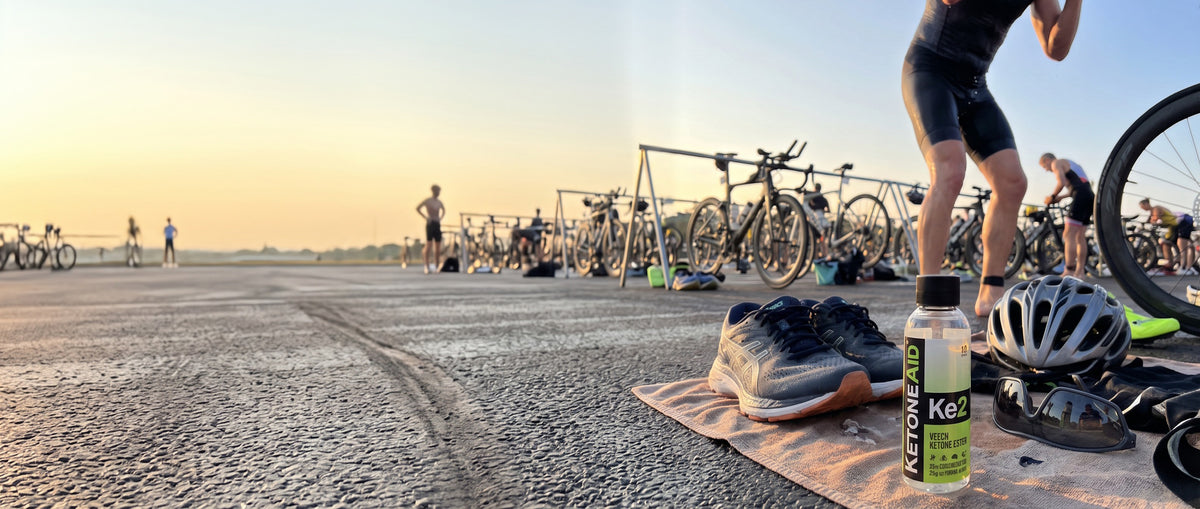
3 disciplines.
A 4th fuel.
Focus. Energy. Recovery.
Veech Ketone Ester provides D-BHB — an additional fuel your brain and muscles can use alongside your normal carbs and hydration.
A food, not a stimulant.
Brain. Muscle.
Hours of work. Then recovery.
Maintain focus: Pacing. Fueling. Transitions. Don’t drift off course.
PROOF: Across a 60–100km trail run, reaction time held with VKE and slowed without it. Poffé 2023
Same plan.
Keep your carbs. VKE adds D-BHB for additional brain and muscle energy.
WHAT IT IS: The same D-BHB your liver can make — provided rapidly as an additional fuel. Not a stimulant.
Long sessions. Bricks. 2-a-days. Big weekends.
PROOF: After a strenuous training day, sleep efficiency improved and the drop in REM was countered. Robberechts 2023

Add another fuel.
Keep your carbs and hydration. VKE does a different job.
Race fuel.
Keep them.
Hydration.
Keep them.
A stimulant.
VKE isn’t one.
Another fuel for brain + muscle.
Add it to the plan.
Train with it.
Don’t just race with it.
Another fuel is the start. The bigger reason:
some of the strongest results came from training with it.
LATE-SESSION POWER
Final 30 minutes of a 2-hour session during a 3-week overload block. Poffé 2019
SUSTAINABLE TRAINING LOAD
In week 3 of the same overload block. More quality load absorbed. Poffé 2019
Recovery: after a strenuous training day, ~90% of the exercise-induced extra wakefulness was reversed. Robberechts 2023
VKE isn’t just something to carry on race day.
Some of the strongest results came from training with it.
Swim. Bike. Run.
One more fuel across the whole day.
Nothing you already carry comes out.
Nothing to take in the water.
Pre-race VKE is part of the whole-day fuel plan, not a swim tactic.
Hours of work. The easiest place to keep fueling.
Keep carbs and hydration. VKE rides alongside them as additional fuel.
The work isn’t over at T2.
Some of the most relevant VKE cognition-under-fatigue evidence comes from prolonged running.
HOW AND WHEN: THE TRIATHLON PROTOCOL ↓

Stay sharp when the
event gets long.
5–17 hours of pacing, fueling and decisions — most of them made tired.
In a 60–100km trail-running trial, the control group’s reaction time slowed as the hours passed. With VKE it didn’t. Finishing time wasn’t measured.
REACTION TIME IN CONTROL, START TO FINISH
That deterioration was negated with VKE.
CIRCULATING DOPAMINE
4.1 vs 2.4nM after the effort. Alertness maintained where control declined.

Race day is occasional.
Training is the sport.
Long ride. Long run. Brick. 2-a-day. Big weekend. This is where VKE can become part of the training week — not just race day.
THE ADVANTAGE CAN BE BUILT BEFORE RACE DAY.
3-WEEK OVERLOAD · LATE-SESSION POWER AND SUSTAINABLE LOAD
2 sessions a day for 3 weeks, VKE after each. Power in the final 30 minutes 15% higher; week-3 training load 15% higher. Overreaching blunted.
POFFÉ 2019 · J PHYSIOL · PMID 31039280
8 WEEKS · 30-MINUTE TIME-TRIAL POWER
302 W vs 291 W. Post-session and pre-sleep for 8 weeks. The gain came from training with it, not from taking it before the test.
ROBBERECHTS 2026 · J PHYSIOL · PMID 41757674
RECOVERY · EXTRA WAKEFULNESS REVERSED
After a strenuous training day: sleep efficiency improved, ~90% of the exercise-induced extra wakefulness reversed, post-exercise REM decline countered.
ROBBERECHTS 2023 · MSSE · PMID 37259248
Not one serving to carry on race day. After key sessions. After bricks. Before bed on the hard days. Amounts are on the protocol page.
Used where the day gets long.
“Used for 70.3. Kept me constant, didn’t run low on energy, combined with carbs.”S C.
HALF IRONMAN · KETONEAID CUSTOMER REVIEW
“It helps to keep my energy stable.”
Sports dietitian and long-course coach. Carried Ke4 through the 2024 Chattanooga race after using it at Norseman and ICON XTRI, taking small amounts when she wanted a mental boost. Reported stable energy and no stomach issues.
MARNI SUMBALTRIMARNI · 2024 CHATTANOOGA RACE RECAP (PUBLIC)RACE RECAP ↗
“Game changer.”
Used KetoneAid on all 3 race days and again post-race as part of recovery. Wrote that for her it made a large difference in mental clarity and recovery.
VIKTORIA BROWNULTRAMAN FLORIDA 2024 · 1ST WOMAN
KETONEAID-SUPPORTED ATHLETERACE RECAP ↗
Individual experiences, not clinical results. Viktoria Brown has a material relationship with KetoneAid.
Pre-race. During. Post-race.
That’s the protocol.
3 beats. Exact amounts live on the VKE protocol page. First-time rule: test the exact amount and timing in training, never for the first time on race morning.
Start with the empty-stomach window.
The KetoneAid sport protocol starts VKE on an empty stomach. Build your established race nutrition around that window, and test the exact sequence in training. Too much before a high-intensity start can backfire — start small.
The bike is the natural access point.
You can drink, and the run is still ahead. For carb-fueled racing, VKE rides alongside carbs, not instead of them. A Ketone Shot fits a bento box or jersey pocket.
DUAL-FUEL NOTE · KETONEAID PROTOCOL GUIDANCELayering VKE into a carb-based race plan may call for roughly 15% more carbohydrate. See the full protocol for amounts and timing.
After key sessions. After bricks. Before bed on hard days.
This is where the repeated-use training evidence is strongest: post-session and pre-sleep, through the block. Some athletes use VKE only for this.
CARB-FUELED / DUAL-FUEL
Keep your carbs. Layer VKE into the plan. KetoneAid’s dual-fuel guidance may call for roughly 15% more carbohydrate.
LOW-CARB / FAT-ADAPTED
VKE can also fit a low-carb or fat-adapted strategy without adding a heavy carbohydrate load. If that is how you already train and race, use a low-carb / fat-adapted VKE strategy rather than forcing the dual-fuel approach.
Your fueling strategy changes the protocol. It doesn’t change the molecule.
VKE does not replace water or sodium. Keep your electrolytes, especially with repeated servings or in the heat. If carbohydrate is part of your fueling plan, VKE is additional fuel — not a reason to remove it. VKE is not a cramp product.
Friends don’t let friends mix VKE with C8 MCT oil (possible GI issues).
Serving sizes, dual fuel, pre-loading and sleep-for-sport are all on the protocol page.
Join the community of over 5,000 members. Get advice or share your experience — what worked, what didn’t.
Human endurance results
that matter here.
REACTION TIME HELD UNDER PROLONGED FATIGUE
Control slowed from 353 to 419ms. VKE didn’t. Circulating dopamine roughly doubled.
POFFÉ 2023 · J APPL PHYSIOL · PMID 37141424
TIME-TRIAL POWER AFTER 8 WEEKS OF TRAINING WITH VKE
302 W vs 291 W. Citrate synthase and OXPHOS complex II made the adaptation concrete.
ROBBERECHTS 2026 · J PHYSIOL · PMID 41757674
LATE-SESSION POWER / SUSTAINABLE LOAD DURING OVERLOAD
2 sessions a day for 3 weeks. Overreaching blunted; late-session power and week-3 load both about 15% higher.
POFFÉ 2019 · J PHYSIOL · PMID 31039280
Recovery: sleep efficiency improved and ~90% of exercise-induced extra wakefulness reversed after a strenuous training day. Robberechts 2023
Proper results depend on proper use.
Same molecule. Different protocol. Different result. VKE outcomes change with dose, timing, duration, carbohydrate context, training state and the performance question being tested.
That is why we publish the nulls alongside the positive trials: they show which protocols produced which outcomes. A null result in one acute protocol is not a blanket verdict on VKE.
Across prolonged-fatigue, recovery and repeated-use training protocols, VKE has produced meaningful human results.
Tri it.
Concentration decides taste. All three are the same Veech Ketone Ester at different dilutions.
 MOST CONCENTRATED · COMPACTKe450% VKE · 30g PER BOTTLEMost concentrated. The most VKE in the fewest bottles, and the most potent taste.SHOP KE4
 MULTI-SERVING · TRAINING BLOCKKe225% VKE · 25g PER BOTTLESame Veech Ketone Ester, more diluted and easier to drink.SHOP KE2
 RACE-DAY FORMAT · EASY TO CARRYKetone Shot8% VKE · 5g READY TO DRINKLowest-friction way to try VKE or carry a single serving.SHOP KETONE SHOT
ALL KETONEAID PRODUCTS ARE 3RD-PARTY BATCH TESTED FOR WADA-PROHIBITED SUBSTANCES.
ATHLETES: CHECK YOUR EVENT’S CURRENT RULES.
Considering VKE for your club or program? Contact us.
- A protocol built around your squad’s sessions, bricks and race calendar.
- Product for your athletes to trial, at club and program pricing.
- Straight answers on the research: what’s measured, what isn’t, and how to talk about it with an athlete.
- All KetoneAid products are 3rd-party batch tested for WADA-prohibited substances; certificate available on request.
The research behind the triathlon page.
Cycling and running trials, the recovery and sleep work, and the nulls. Every entry names the molecule, the population and the PMID. Research servings are not consumer instructions.
60–100km trail running: the decline in reaction and movement execution seen in control was negated.
Poffé et al. 2023 · Journal of Applied Physiology
18 recreational runners · 9 VKE / 9 control · PMID 37141424
Poffé et al. 2023 · Journal of Applied Physiology
18 recreational runners · 9 VKE / 9 control · PMID 37141424
PROTOCOL Eighteen recreational runners attempted 60–100km on trail. Eight completed 100km, six stopped at 80km, four at 60km. The ketone group received 25g before the run, 25g per hour during it, then five further 25g servings over the next 24 hours. Blood D-BHB ran about 2–3mM against under 0.3mM in control.
WHAT HAPPENED
- Visual reaction time in control went from 353ms to 419ms across the effort. That deterioration was fully negated with VKE.
- Movement execution time in control went from 174ms to 245ms. Also fully negated.
- Plasma dopamine roughly doubled during the run, 4.1 against 2.4nM after it.
- Post-run muscle markers differed, including lower macrophage infiltration and suppressed AMPK phosphorylation out to 36 hours.
WHY IT MATTERS
- This is the strongest direct runner-specific result that exists, and it is about cognition rather than speed.
- The finding is preservation, not enhancement: control got worse and VKE did not.
- The authors read the muscle markers as improved muscular energy status during recovery.
CONTEXT: Recreational runners, nine per group, and a research dosing protocol far larger than anything we recommend. No finishing-time claim is made or implied. PMID 37141424, doi 10.1152/japplphysiol.00791.2022 — PubMed
After a hard training day: improved sleep efficiency and most of the extra wakefulness reversed.
Robberechts et al. 2023 · MSSE
10 trained cyclists · polysomnography · PMID 37259248
Robberechts et al. 2023 · MSSE
10 trained cyclists · polysomnography · PMID 37259248
PROTOCOL Ten trained cyclists completed morning endurance work and evening HIIT ending one hour before bedtime. They received 25g of VKE after exercise and a further 25g thirty minutes before bed, or placebo. Sleep was measured with polysomnography.
WHAT HAPPENED
- The training day alone reduced REM sleep by 26% and increased wakefulness after sleep onset by 95%.
- VKE improved sleep efficiency by 3%.
- Roughly 90% of the exercise-induced extra wakefulness was reversed.
WHY IT MATTERS
- Stage racing is this problem repeated: perform, recover, do it again tomorrow.
- Polysomnography measures sleep architecture rather than how rested someone reports feeling.
CONTEXT: Ten trained cyclists and a deliberately disruptive exercise protocol. The research doses were larger than we recommend for everyday use. VKE is a food, not a sleep aid. PMID 37259248 — PubMed
Eight weeks of training with it: +4% time-trial power and greater mitochondrial adaptation.
Robberechts et al. 2026 · Journal of Physiology
28 trained males · 14 per group · PMID 41757674
Robberechts et al. 2026 · Journal of Physiology
28 trained males · 14 per group · PMID 41757674
PROTOCOL KU Leuven. Twenty-eight trained males completed eight weeks of supervised cycling training. Fourteen received 25g of the ketone monoester immediately after each session and again before sleep; fourteen received an isocaloric placebo.
WHAT HAPPENED
- 30-minute time-trial power 302 ± 28 W with VKE against 291 ± 27 W in control, about 4% higher.
- Relative VO2peak improved 12% from baseline with VKE against 6% in control.
- Citrate synthase activity was 14% higher.
- OXPHOS complex II protein increased 25% with VKE and was unchanged in control.
WHY IT MATTERS
- The performance gain came from training with it across eight weeks, not from taking it before the test.
- Citrate synthase and OXPHOS complex II make the mitochondrial-adaptation claim concrete rather than theoretical.
- The authors concluded the improvements were mediated by muscular adaptations; cardiac adaptations were not affected.
CONTEXT: Trained males only, 14 per group, supervised laboratory programme rather than self-directed training. PMID 41757674, doi 10.1113/JP290315 — PubMed
Three-week overload: 15% more late-session power and 15% more sustainable load.
Poffé et al. 2019 · Journal of Physiology
18 fit males · two sessions daily · PMID 31039280
Poffé et al. 2019 · Journal of Physiology
18 fit males · two sessions daily · PMID 31039280
PROTOCOL Three weeks of deliberately excessive cycling designed to induce non-functional overreaching. Nine received a ketone ester after each session and before sleep; nine received a control drink.
WHAT HAPPENED
- Power in the final 30 minutes of a standardized 2-hour session was 15% higher with VKE.
- Sustainable training load in week 3 was also 15% higher.
- The training-induced rise in nocturnal adrenaline and noradrenaline was inhibited.
- Energy balance turned negative in control but not with VKE.
WHY IT MATTERS
- Late in a long session is exactly where training quality normally collapses.
- Absorbing more quality load is the input to adaptation.
CONTEXT: Nine per group, fit males, an overload model built to cause overreaching rather than a normal programme. The difference in energy balance between groups may explain part of the effect. PMID 31039280, doi 10.1113/JP277831 — PubMed
Overload block: capillary contacts up 44%, EPO up about 25%.
Poffé et al. 2023 · Journal of Physiology
18 fit males · muscle biopsies · PMID 37062892
Poffé et al. 2023 · Journal of Physiology
18 fit males · muscle biopsies · PMID 37062892
PROTOCOL Eighteen healthy fit males, three weeks of endurance overload at ten sessions per week. Nine received 25g of ketone ester immediately after each session and 30 minutes before sleep; nine received an isocaloric control. Vastus lateralis biopsies before and after.
WHAT HAPPENED
- Capillary contacts increased 44% with VKE and not in control.
- The capillary-to-fibre perimeter exchange index increased 42%.
- Serum EPO rose about 25% and was unchanged in control.
- Pro-angiogenic VEGF and eNOS also increased in muscle.
WHY IT MATTERS
- More capillary contact per fibre shortens the oxygen delivery distance into working muscle.
- Heavy overload normally blunts capillary growth. Here it didn't.
CONTEXT: Nine per group, fit males, three weeks of deliberate overload. These are measures of muscle capillarisation and circulating EPO, not clinical outcomes, and not comparable to administered erythropoietin. PMID 37062892, doi 10.1113/JP284346 — PubMed
3-hour race simulation with carbohydrate on board: no glycogen sparing and no time-trial gain.
Poffé et al. 2020 · Journal of Applied Physiology
12 highly trained male cyclists/triathletes · randomized crossover · PMID 32407242
Poffé et al. 2020 · Journal of Applied Physiology
12 highly trained male cyclists/triathletes · randomized crossover · PMID 32407242
PROTOCOL KU Leuven. 12 highly trained male cyclists, including triathletes, completed a simulated race twice: 3 hours of intermittent cycling, a 15-minute time trial, then a maximal sprint. Both times they took 60g of carbohydrate per hour. In one condition they also took the ketone monoester in 3 servings (25, 20 and 20g) at 60 and 20 minutes before the start and 30 minutes in.
WHAT HAPPENED
- Blood D-BHB rose to about 3mM during the first half of the race, then fell as the servings stopped.
- Net muscle glycogen breakdown over the 3 hours did not differ between conditions.
- Time-trial and sprint performance did not differ.
- Blood pH and bicarbonate fell transiently with the ester. Appetite immediately after exercise was lower.
WHY IT MATTERS FOR TRIATHLON
- This is the only monoester trial we know of with triathletes in the cohort — and the test was cycling, not swim-bike-run.
- It sets the expectation: with carbohydrate on board, VKE did not spare glycogen or add watts at the end of a long ride. That is not what the page claims it does.
- The research servings were far larger than anything we recommend, and front-loaded into the first 90 minutes.
CONTEXT: Males only, 12 participants, laboratory race simulation. A null result on performance, published here on purpose. PMID 32407242, doi 10.1152/japplphysiol.00092.2020 — PubMed
Post-exercise glycogen, 2 studies: 50% higher with the ester plus glucose; no difference with a standard recovery drink.
Holdsworth et al. 2017 · MSSE 49(9):1789–95 · PMID 28398950
Vandoorne et al. 2017 · Frontiers in Physiology 8:310 · PMID 28588499
Holdsworth et al. 2017 · MSSE 49(9):1789–95 · PMID 28398950
Vandoorne et al. 2017 · Frontiers in Physiology 8:310 · PMID 28588499
PROTOCOL Holdsworth: after glycogen-depleting exercise, athletes received the ketone monoester or placebo, then a 2-hour hyperglycemic clamp holding blood glucose high. Vandoorne: after glycogen-depleting exercise, athletes received the ester or placebo alongside a standard protein-and-carbohydrate recovery drink over 5 hours.
WHAT HAPPENED
- Holdsworth: glucose uptake was 32% faster and muscle glycogen 50% higher with the ester (246 against 164 mmol/kg dry weight).
- Vandoorne: no difference in glycogen resynthesis, but higher mTORC1 signalling with the ester.
WHY IT MATTERS FOR TRIATHLON
- Proper results depend on proper use. The same molecule produced a large glycogen difference in one protocol and none in another.
- The difference was the feeding context: a glucose clamp against a mixed recovery drink taken at the same time.
- This is why the protocol page suggests keeping a recovery drink clear of the ester rather than mixing them.
CONTEXT: Both small, both laboratory recovery protocols. Neither is a faster-recovery claim; together they are a protocol-dependence example. PMID 28398950 — PubMed · PMID 28588499 — PubMed
Running economy: 4.1% better with the monoester, but only without carbohydrate.
Brady & Egan 2024 · MSSE 56(1):134–142
11 male middle- and long-distance runners · PMID 37565450
Brady & Egan 2024 · MSSE 56(1):134–142
11 male middle- and long-distance runners · PMID 37565450
PROTOCOL Placebo-controlled randomized crossover, three conditions: a 10% carbohydrate solution; the same carbohydrate solution with 750mg per kg of the ketone monoester; or 750mg per kg of the monoester in flavoured water. Five 8-minute submaximal treadmill stages at 10–14 km/h, then a ramp test to exhaustion.
WHAT HAPPENED
- The monoester without carbohydrate reduced the oxygen cost of submaximal running by an average of 4.1%.
- The monoester with carbohydrate did not improve economy.
- Time to exhaustion on the ramp test was unchanged.
WHY IT MATTERS
- Fuel context changed the result within the same group of runners.
- Running economy is a measure of oxygen cost at a given speed. It is not race time, and this study did not measure one.
CONTEXT: Eleven male runners, acute laboratory protocol. Read alongside the 2025 follow-up below rather than on its own. PMID 37565450, doi 10.1249/MSS.0000000000003278 — PubMed
The follow-up: advanced footwear improved running economy. The monoester did not.
Brady et al. 2025 · MSSE 57(7):1559–1569
18 runners, 10 male / 8 female · PMID 39999362
Brady et al. 2025 · MSSE 57(7):1559–1569
18 runners, 10 male / 8 female · PMID 39999362
PROTOCOL Four-condition placebo-controlled randomized crossover in 18 middle- and long-distance runners, testing advanced footwear technology and acute monoester ingestion separately and together. Five 8-minute submaximal stages, then a ramp test to exhaustion. 500mg per kg of the monoester 20 minutes before exercise.
WHAT HAPPENED
- Advanced footwear improved running economy.
- Acute monoester ingestion did not.
WHY IT MATTERS
- It is the direct follow-up to the 2024 result, from the same research group, and it did not reproduce the economy advantage.
- The dose and fuel context both differed from the 2024 protocol, which is the argument of this page.
CONTEXT: Ten men and eight women, acute protocol. Included because a page arguing that protocol decides the outcome has to show the protocols that didn't work. PMID 39999362, doi 10.1249/MSS.0000000000003682 — PubMed
10km: no benefit on running performance.
Evans, McSwiney, Brady & Egan 2019 · MSSE 51(12):2506–2515
Trained middle- and long-distance runners · PMID 31730565
Evans, McSwiney, Brady & Egan 2019 · MSSE 51(12):2506–2515
Trained middle- and long-distance runners · PMID 31730565
PROTOCOL Trained middle- and long-distance runners completed an hour of treadmill running at roughly 65% VO2max with carbohydrate plus either placebo or the ketone monoester, followed by a 10km time trial.
WHAT HAPPENED
- No significant benefit on 10km performance.
- Blood beta-hydroxybutyrate rose as expected; the performance endpoint did not move.
WHY IT MATTERS
- It is the clearest direct evidence against a short-race speed claim in runners.
- The monoester was co-ingested with carbohydrate, which the 2024 economy study later showed changes the result.
CONTEXT: Small trained sample, acute protocol. PMID 31730565, doi 10.1249/MSS.0000000000002065 — PubMed
31 days of high-dose monoester: no 5km improvement, though some cognitive and physiological measures changed.
Prins et al. 2026
Recreational runners · PMID 41773904
Prins et al. 2026
Recreational runners · PMID 41773904
PROTOCOL A 31-day high-dose ketone monoester trial in recreational runners, testing 5km performance alongside cognitive and physiological measures.
WHAT HAPPENED
- 5km performance did not improve.
- Response speed on cognitive tasks improved.
- Some exercise-physiology measures changed.
WHY IT MATTERS
- It tests repeated use rather than an acute dose, and still found no short-race speed benefit.
- It is consistent with the rest of this page: the runner-specific signal is cognitive, not 5km speed.
CONTEXT: Recreational runners, high-dose protocol. PMID 41773904, doi 10.1080/27697061.2026.2636551 — PubMed
Short flat-out effort: mean power about 1.5% lower in the ketone conditions.
Poffé, Wyns et al. 2021 · MSSE 53(5):1068–1078
Well-trained cyclists · with and without bicarbonate · PMID 33196605
Poffé, Wyns et al. 2021 · MSSE 53(5):1068–1078
Well-trained cyclists · with and without bicarbonate · PMID 33196605
PROTOCOL A 60-minute warm-up at low-to-moderate intensity including several harder efforts, then a 30-minute simulated time trial and an all-out sprint, under placebo, ketone ester, bicarbonate, or both.
WHAT HAPPENED
- Mean power in the 30-minute time trial was about 1.5% lower in the ketone conditions, with blood D-BHB around 3–4 mM.
- Bicarbonate did not rescue it — hence the title, independent of bicarbonate supplementation.
- Sprint time to exhaustion was unchanged across all conditions.
WHY IT MATTERS
- It tested a short, maximal effort with high acute ketonemia — a different question from the longer-duration and training-block protocols.
- Bicarbonate did not rescue the result, so acid-base disturbance isn't the whole explanation.
- Duration, timing, dose, fueling state and baseline metabolic context all differ between these protocols.
CONTEXT: Well-trained male cyclists. Read alongside the 3-hour study rather than instead of it. PMID 33196605 — PubMed
After exhausting intermittent exercise: no rise in multitasking errors with VKE; errors rose with carbohydrate alone.
Evans & Egan 2018 · Medicine & Science in Sports & Exercise
11 male team-sport athletes · double-blind crossover · PMID 29944604
Evans & Egan 2018 · Medicine & Science in Sports & Exercise
11 male team-sport athletes · double-blind crossover · PMID 29944604
PROTOCOL Dublin City University. Eleven male team-sport athletes completed the Loughborough Intermittent Shuttle Test twice: five 15-minute blocks of intermittent running, then a shuttle run to exhaustion. A 6.4% carbohydrate drink was taken before and during, either alone or with 750 mg/kg of the ketone monoester. A cognitive battery ran before and after.
WHAT HAPPENED
- Blood D-BHB reached roughly 1.5–2.6 mM during exercise with the ester.
- Incorrect responses on a multitasking test rose from pre- to post-exercise with carbohydrate alone (mean +1.8) but not with the ester (0.0); p = 0.017, d = 0.70.
- Reaction time and sustained attention did not differ between conditions.
- Sprint times, heart rate, perceived exertion and run time to exhaustion did not differ.
WHY IT MATTERS FOR TRIATHLON
- The effect was on executive function — juggling more than one thing at once — after the body was tired. That is a pacing and fueling call at hour four.
- Not a running-performance result. The authors describe a cognitive benefit, not a physical one.
- A team-sport shuttle protocol, so it is context for cognition under fatigue rather than a triathlon result.
CONTEXT: Small sample, males only, single acute dose, carbohydrate in both arms. PMID 29944604, doi 10.1249/MSS.0000000000001700 — PubMed
Under mental fatigue: VKE prevented the decline placebo showed; with caffeine, task-switching was ~0.1 sec quicker.
Roca, Barker & Waldman 2026 · Journal of Strength and Conditioning Research
PMID 42429835
Roca, Barker & Waldman 2026 · Journal of Strength and Conditioning Research
PMID 42429835
PROTOCOL Participants completed a mental-fatigue protocol under ketone monoester alone, ketone monoester with caffeine, and placebo, with cognitive testing including a task-switching measure.
WHAT HAPPENED
- Task-switching was 97 ms quicker in the monoester-plus-caffeine condition than with placebo.
- The monoester alone primarily prevented the decline seen with placebo rather than producing a gain from rest.
WHY IT MATTERS FOR TRIATHLON
- A long day is hours of switching: pace, nutrition timing, course, the next transition.
- The accurate read is protection, not enhancement: the ester alone kept performance where it started while placebo slipped.
- Caffeine was part of the strongest condition. Most triathletes already have caffeine in their plan; this is context, not a recommendation to add more.
CONTEXT: Laboratory mental-fatigue task, not sport. Caffeine was part of the strongest condition. PMID 42429835 — PubMed
Ketones and triathlon
Do other types of ketones do this?
No. These results belong to VKE.
Every result on this page comes from the Veech Ketone Ester — the D-BHB ketone monoester that was actually studied.
R 1,3 butanediol, ketone salts, D-BHB free acid and other ketone esters are different molecules or formulations. They do not inherit VKE’s results.
If a brand sells a different molecule while citing VKE research, that research is evidence for VKE — not for what they’re selling.
Check the molecule.
How do I keep my energy up during a triathlon?
Build a fueling plan you can execute for the whole event. Keep your carbs, hydration and electrolytes. Then add VKE as another fuel your brain and muscles can use.
In prolonged running under fatigue, athletes taking VKE maintained mental alertness while control declined. For triathlon, that is one reason VKE belongs alongside the race nutrition you already use — not instead of it.
How do I avoid fading on the run?
Pace the bike within yourself, fuel it properly, and don’t arrive at T2 already behind on calories or sodium. That is most of it.
VKE adds a second fuel your brain can use late in the day. Across a 60–100km run, reaction time held with VKE while the control group slowed. That evidence is about staying sharp under long fatigue, not about running faster off the bike.
What should I eat before a triathlon?
Whatever you have practised: a familiar breakfast, early enough to settle, with your usual carbohydrate.
If you use VKE pre-race, the protocol page explains why it works best on an empty stomach and how to fit it around a race breakfast. Test that exact sequence in training first.
How do I fuel a 70.3?
Carbohydrate per hour on the bike, sodium to match your sweat, and a plan you have rehearsed on long training days. Those are the foundations.
VKE fits on top of that plan as an additional fuel, taken alongside carbohydrate on the bike. KetoneAid protocol guidance — not a study result — is that layering VKE into a carb-based plan may call for roughly 15% more carbohydrate. The protocol page covers the amounts.
What should I take on the bike leg?
Carbs, water and electrolytes come first. The bike is the easiest discipline in which to keep fueling, so most of your race calories happen there.
A Ketone Shot fits a bento box or jersey pocket, and the bike is the natural window for VKE because the run is still ahead. Keep the carbs; add the fuel.
How do I stay focused during a long triathlon?
Long-course focus is mostly fuel and fatigue, not willpower. Eat and drink to plan, break the day into segments, and make the big decisions — pacing, nutrition — before you are tired.
VKE is the fuel part. In a 60–100km running trial, reaction time and movement execution slowed across the effort in the control group and held in the group taking Veech Ketone Ester. That is preservation under fatigue, not a boost from rest.
What are the best supplements for triathletes?
‘Triathlon supplements’ is the search term, but Veech Ketone Ester is not a dietary supplement. It is food — an additional fuel.
Carbohydrate, hydration and electrolytes still matter. Caffeine is a stimulant. VKE is different: it provides D-BHB your brain and muscles can use, with human evidence spanning prolonged fatigue, recovery and repeated-use training.
How do I recover after a triathlon?
Eat, rehydrate, sleep, and give the next hard session the respect the distance deserves.
In a trial after a strenuous training day, VKE taken post-exercise and again before bed improved sleep efficiency and countered the drop in REM sleep. That is the recovery beat of the protocol.
How do I recover from brick workouts?
Treat a brick as one long session: fuel it as a whole, then recover from it as a whole.
Nothing has been measured on a brick specifically. The recovery evidence — better sleep efficiency after a strenuous day, and a 3-week overload block tolerated with less overreaching — is what applies. Take VKE after the session, and before bed if it was a hard one.
How do I recover between 2-a-day sessions?
Refuel promptly after the first session, keep sodium up, and protect sleep.
This is the use case the overload research speaks to: 2 sessions a day for 3 weeks, with VKE after each session. The group taking it sustained about 15% more training load and showed fewer signs of overreaching. Some athletes use VKE only for this.
Do I still need electrolytes?
Yes. Fuel is not hydration. VKE does not replace water or sodium, and it is not a cramp product. Keep your electrolytes, especially with repeated servings or in the heat. If carbs are part of your fueling strategy, keep those too.
Can I take VKE with caffeine?
You can, and most triathletes already have caffeine in their plan. One 2026 mental-fatigue study found the monoester plus caffeine gave the quickest task-switching, while the monoester alone mainly prevented the decline placebo showed.
That is interesting evidence, not a recommendation to add caffeine. Customers frequently report caffeine feels stronger with VKE — more jitters, a crash, and sleep disruption if taken late in a long day. Reduce your normal amount if you combine them.
Will VKE upset my stomach over hours?
In a study that tracked gut symptoms during 3.25 hours of cycling, the ketone monoester taken with carbohydrate produced no more symptoms than carbohydrate alone. At rest and at large research servings, mild symptoms were more common.
Our protocols use a fraction of those research servings. Test yours in training. And: friends don’t let friends mix VKE with C8 MCT oil (possible GI issues).
Is VKE legal in competition?
Veech Ketone Ester is a food, not a drug and not a dietary supplement. VKE is not listed on the current WADA Prohibited List. All KetoneAid products are 3rd-party batch tested for WADA-prohibited substances. Athletes remain responsible for what they consume and for checking their event’s current rules.
What does VKE do for the swim?
There is nothing to take in the water, and no swim-performance benefit has been measured. Pre-race VKE is part of the whole-day fuel plan — the swim just happens to come first.
Does VKE replace carbs?
No. If carbs are part of your race plan, keep them. VKE is additional fuel — not a reason to remove carbohydrate from a carb-fueled strategy.
In one 3-hour cycling protocol, athletes consumed 60g carbohydrate/hour and adding VKE did not spare glycogen or improve finishing performance. That is one protocol result — not a verdict on VKE.
Other VKE protocols, including repeated post-exercise use during training, produced positive performance and adaptation results.
Different fuel. Different role. Proper results depend on proper use.
Do I have to take VKE with carbs?
No. VKE can be used with or without carbohydrate. The right protocol depends on how you already fuel.
Carb-fueled athletes can layer VKE into their existing race nutrition. Low-carb and fat-adapted athletes may use VKE in a lower-carbohydrate context instead.
The studies themselves show that carbohydrate context can change the outcome — another reason proper results depend on proper use.
Is VKE a stimulant?
No. It contains no caffeine and no stimulant of any kind. It is a food that provides D-BHB, a fuel. Some athletes take it before bed on hard training days for that reason.
Which VKE should a triathlete start with?
All three are the same Veech Ketone Ester at different dilutions. Ketone Shot is the lowest-friction way to try it and the easiest to carry on race day. Ke2 is easier to drink day after day through a training block. Ke4 is the most concentrated — the most VKE in the fewest bottles, and the most potent taste.
Has VKE been studied in triathletes?
Yes. Triathletes were included in a 3-hour VKE cycling study alongside highly trained cyclists.
That study tested cycling, not a complete swim-bike-run race. Other evidence on this page comes from running, cycling, training-adaptation and recovery studies: reaction time held across a 60–100km run, +4% time-trial power after 8 weeks of training with VKE, +15% late-session power in a 3-week overload, and improved sleep efficiency after a strenuous training day.
Does VKE spare glycogen?
In a 3-hour race simulation with carbohydrate taken throughout, no. Muscle glycogen breakdown and finishing performance did not differ. In post-exercise recovery the picture depends on the protocol: 50% higher glycogen with the ester plus a glucose clamp, no difference alongside a standard recovery drink. Proper results depend on proper use.
Veech Ketone Ester is a food, not a dietary supplement and not a drug. The studies cited on this page used the D-BHB ketone monoester in cyclists, runners and other athletes; no triathlon finishing time was measured. Athlete experiences are individual, not clinical results. Research servings are not consumer instructions — see the protocol page for amounts. All KetoneAid products are 3rd-party batch tested for WADA-prohibited substances; athletes remain responsible for checking their event’s current rules. Not a cramp product, not hydration, not a carbohydrate replacement.