

Foundational metabolism
Veech studies ketones as a problem in cellular energetics.
Dr. Richard Veech spent much of his NIH career studying cellular energetics, redox chemistry and ketone metabolism. Earlier, he worked with Nobel laureate Hans Krebs.
Cart
Your cart is empty

Veech Ketone Ester · Science authority
The Veech Ketone Ester is (R)-3-hydroxybutyl (R)-3-hydroxybutyrate — the ketone monoester developed through the work of Dr. Richard Veech and Todd King at the National Institutes of Health, with collaborators including researchers at the University of Oxford.
It is also the molecule behind the deepest body of exogenous-ketone human research. Those studies did not test “ketones.” They tested the Veech Ketone Ester. Raising blood D-BHB is only one part of the story — different ketone compounds have different chemistry, pharmacokinetics and human outcomes.
Start here
$10MDARPA project, initial budget
DARPA's Metabolic Dominance program funded several groups to find a fuel that would let soldiers go further on less. The award to Dr. Richard Veech at the NIH and Professor Kieran Clarke at Oxford produced the Veech Ketone Ester. Several brands cite that research. Only one molecule was funded by it.
Figures verified September 2026.
Scientific lineage
The research came first. The consumer category came much later.
Dr. Richard Veech spent much of his NIH career studying cellular energetics, redox chemistry and ketone metabolism. Earlier, he worked with Nobel laureate Hans Krebs.
At the NIH, Todd King worked alongside Veech on ketone metabolism and practical exogenous ketone compounds.
The objective was unusually ambitious: could metabolism be manipulated nutritionally to help sustain physical and cognitive performance under extreme conditions?
Researchers at the University of Oxford collaborated with the NIH team on development and early human testing.
Not a generic category called “ketones.” One specific molecule: the Veech Ketone Ester.
The molecule
One chemically bonded molecule designed to deliver a ketone directly and a ketone precursor that generates additional ketones downstream.
One defined molecule
(R)-3-hydroxybutyl (R)-3-hydroxybutyrate
D-BHB is the primary circulating physiological ketone body.
Primarily through liver metabolism, the precursor generates additional D-BHB and acetoacetate downstream.
The bond is key. The esterified molecule itself is what gets administered and tested. It is not simply D-BHB Free Acid + R 1,3 butanediol mixed together as two ingredients. Human head-to-head research shows the bonded ester and unbonded blend do not produce identical pharmacokinetics.
Why ketones?
Ketones are not simply another source of calories. Their metabolism interacts differently with mitochondrial energy pathways than glucose or fatty acids.
In a 1995 experiment led by Sato, Kashiwaya, Veech and colleagues, working rat hearts were supplied with D-BHB and acetoacetate.
The ketone-body condition made the mitochondrial NAD couple more reduced while making the coenzyme-Q couple more oxidized — increasing the effective redox span across part of the electron-transport system.
Researchers also reported greater cardiac mechanical efficiency compared with glucose alone.
Conceptual mechanism
Important distinction: the 1995 experiment was not a Veech Ketone Ester human trial. Rat hearts were perfused directly with D-BHB + acetoacetate. Its importance is the bioenergetic rationale that helped generate the hypothesis. Human VKE trials had to test the actual molecule.
Human pharmacokinetics
Yes. Early human studies established rapid, substantial D-BHB elevation in the blood.
Human ingestion studies consistently demonstrate millimolar circulating D-BHB after Veech Ketone Ester.
Stubbs et al. showed the monoester produced substantially higher circulating D-BHB than conventional racemic ketone salts.
At the same active dose in the same participants, Veech produced the highest BHB response versus Kenetik and Ketone-IQ.
That establishes the pharmacokinetics. The more interesting question is what happened when researchers stopped measuring only the ketone meter.
Human performance research
Acute pre-exercise results have been mixed. The more consistent positive signal has emerged when Veech Ketone Ester is incorporated into recovery and repeated endurance training.
An influential acute study reported improved cycling distance after a one-hour preload. Subsequent acute protocols produced neutral and at least one negative result.
Takeaway: Veech Ketone Ester is not a universal magic pre-workout. Protocol matters.
During three weeks of intensive endurance-training overload, participants used Veech Ketone Ester as part of post-exercise recovery.
Twenty-eight trained men completed supervised cycling training. The ketone group consumed 25g after exercise and before sleep; control received an isocaloric placebo.
Interpretation
Veech Ketone Ester did not replace training.
It appeared to amplify the adaptation to training.
Recovery physiology
Post-exercise studies have investigated training tolerance, muscle signaling, glycogen metabolism, mitochondrial adaptation, erythropoietin, skeletal-muscle angiogenesis and more.
It doesn't.
The stronger conclusion is that, in controlled human studies, Veech Ketone Ester interacted with post-exercise metabolism and training adaptation in ways that produced measurable downstream effects under the protocols tested.
And the strongest downstream evidence is performance itself.
Human cognition research
Functional MRI compared glucose and ketone fuel conditions.
Glucose destabilized brain networks.
Veech Ester stabilized them.
During a 100 km trail run, placebo runners showed slower reaction and movement times. Veech Ketone Ester maintained psychocognitive performance and raised circulating dopamine.
Study material purchased from KetoneAid Inc.
Veech Ketone Ester raised BHB to ~1.5 mM and prevented the cognitive decline seen with placebo.
Cognitive flexibility and selective attention were maintained more effectively under mental fatigue.
Breadth of evidence
The case for Veech Ketone Ester does not rest on one study, one biomarker or one research group.
Human work spans pharmacokinetics, exercise performance, training adaptation, recovery physiology, cognition, cerebral blood flow, metabolism and cardiovascular physiology.
Full evidence, not cherry-picking
“Drink ketones immediately before exercise and automatically perform better” is not supported by the full record.
The stronger evidence has increasingly emerged around post-exercise use, training adaptation, repeated supplementation and specific cognitive conditions.
Naming matters
Many papers say “ketone ester,” “KE,” “ketone monoester,” “β-hydroxybutyrate ester” or simply “exogenous ketones.” The molecule used on this page is one specific chemical structure.
(R)-3-hydroxybutyl (R)-3-hydroxybutyrate
That is the Veech Ketone Ester.
A different ketone may raise BHB differently, produce different metabolites, use different metabolic pathways and produce different human results. If a study administered the Veech Ketone Ester, its result belongs to the Veech Ketone Ester.

From science to KetoneAid
There is a personal connection to its origin.
Dr. Richard Veech was the godfather of KetoneAid founder Frank LLosa’s wife. Through that relationship, Frank was introduced directly to Veech, his work and the ketone ester long before “exogenous ketones” became a consumer category.
That connection eventually led to the founding of KetoneAid and its focus on making the actual Veech Ketone Ester available beyond the research setting.
The science came first. KetoneAid came later.
Read studies correctly
The molecule matters. But so do dose, timing, co-ingested nutrients, population and the endpoint being measured — and those study conditions do not always reflect how we think the molecule is best used.
Look for ketone monoester — (R)-3-hydroxybutyl (R)-3-hydroxybutyrate — or a recognized alias.
A 5g serving should not automatically be equated with a 25g research protocol.
Before exercise, after exercise, before sleep or repeatedly for weeks all represent different study protocols.
Carbohydrate and protein availability can materially alter the metabolic response.
BHB, power, cognition, blood flow, signaling and training adaptation are not interchangeable endpoints.
Elite athletes, trained recreational athletes and other adult populations may respond differently.
Frequently asked
The Veech Ketone Ester is D-BHB bound to R 1,3 butanediol — (R)-3-hydroxybutyl (R)-3-hydroxybutyrate — a ketone monoester developed through the work of Dr. Richard Veech and Todd King at the National Institutes of Health, with collaborators including researchers at the University of Oxford, and funded by the US military and government grants. After ingestion, the molecule releases D-BHB directly while its R 1,3 butanediol portion is metabolized into additional ketone bodies.
Its development resulted from research led by Dr. Richard Veech and Todd King at the National Institutes of Health, with collaborators including researchers at the University of Oxford and support including the U.S. DARPA Metabolic Dominance program.
Yes. KME means ketone monoester and is commonly used in scientific literature to refer to (R)-3-hydroxybutyl (R)-3-hydroxybutyrate. Because other ketone esters now exist, “Veech Ketone Ester” is the clearer name.
No. Historically, Veech Ketone Ester was often called simply “the ketone ester” because it was the dominant ester used in human research. Other structurally different ketone esters now exist. Always check the chemical name.
No. The acute exercise-performance literature is mixed. The strongest positive performance evidence has emerged from studies using Veech Ketone Ester during post-exercise recovery and repeated endurance training, while controlled cognition studies have also reported significant positive findings.
Extensively. Human research includes pharmacokinetics, exercise performance, training adaptation, recovery physiology, cognition, cerebral blood flow and other metabolic and physiological outcomes.
KetoneAid conservatively describes the research base as 75+ studies. It is the most extensively studied exogenous ketone.
The key takeaway
The science progressed from ketone bioenergetics → a practical exogenous delivery molecule → human pharmacokinetics → direct performance, cognition and adaptation studies.
Try the molecule
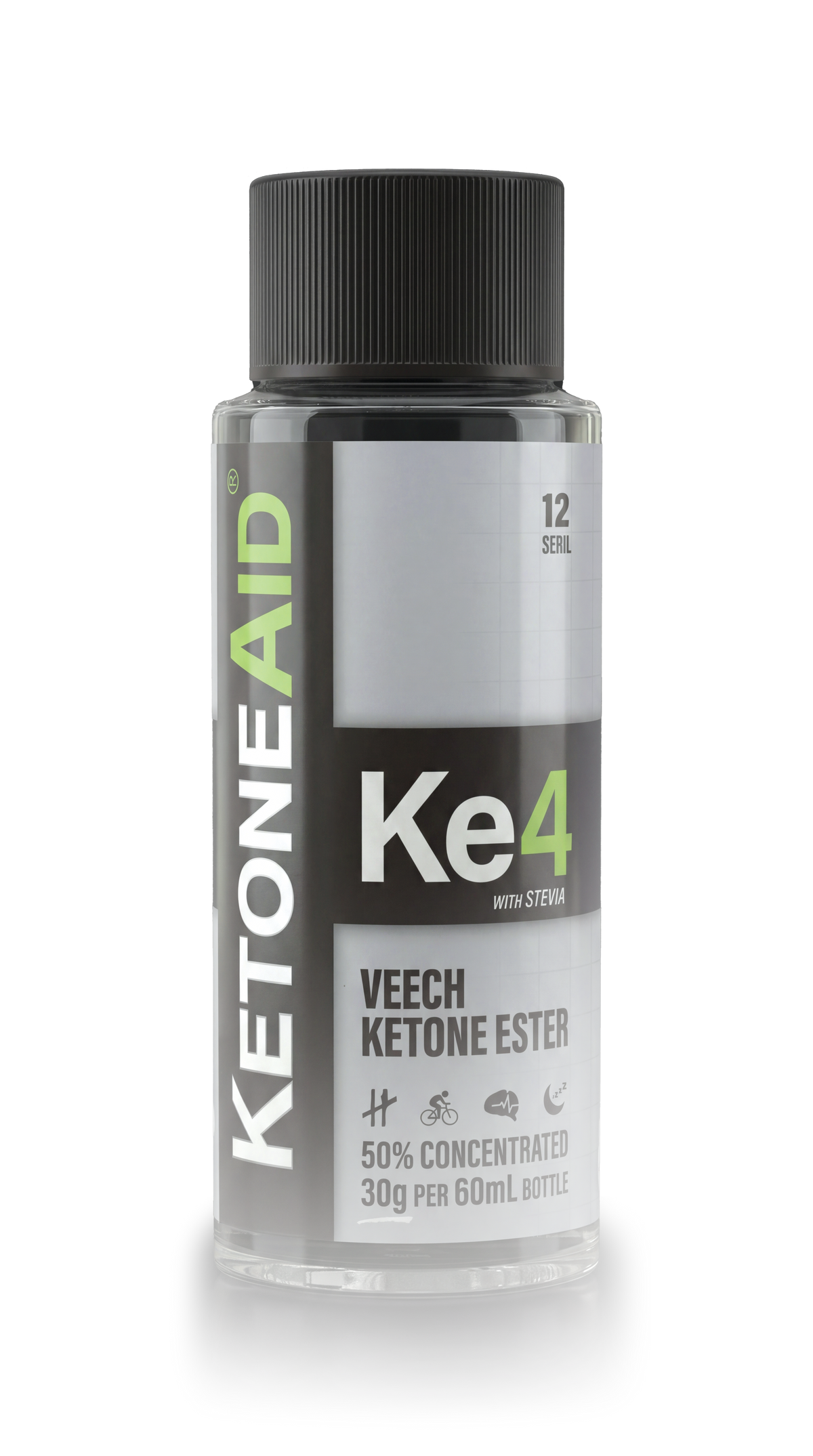
 Ke4 →50% VKE
 Ke2 →25% VKE
 Ketone Shot →8% VKE
Dosing & timing: Ketone Shot · Ke2 · Ke4
Lifetime No-Risk Guarantee · Pay with HSA/FSA
Primary references