
Ketone ester improved time-trial performance by about 2%.
+2%30-MINUTE TIME-TRIAL PERFORMANCE
The original Oxford work, in elite athletes, with the ester taken alongside carbohydrate after 60 minutes at 75% of peak power.
Carrito
Su carrito está vacío

Veech Ketone Ester can work from the first bottle. How well depends entirely on how you use it.
More human research exists on this molecule than on every other exogenous ketone combined. It has improved late-race power, raised aerobic capacity across a training block, and grown the capillary network feeding working muscle. It has also been studied doing nothing at all — in protocols that asked it to do something it was never going to do.
The difference is protocol. That's what this page is about.

100 MILES IN UNDER 24 HOURS · NO CARBOHYDRATE · VKE AND ELECTROLYTES ONLY
Yes — but the protocol matters. Human Veech Ketone Ester trials include improved endurance performance, null results and one negative short-duration protocol. The clearest positive evidence appears in prolonged exercise, in specific co-ingestion protocols, and in repeated post-training use across training blocks.
Professional cycling tests everything and keeps almost nothing. Ketone esters have been in the peloton for years, through a doping-adjacent press cycle and a UCI advisory, and the teams still use them.
KetoneAid is an advisory partner to two WorldTour teams, supplying VKE and protocol optimization support.
STAGES IN THREE WEEKS — THE PUREST TEST
OF ENDURANCE, RECOVERY & REPEAT THERE IS
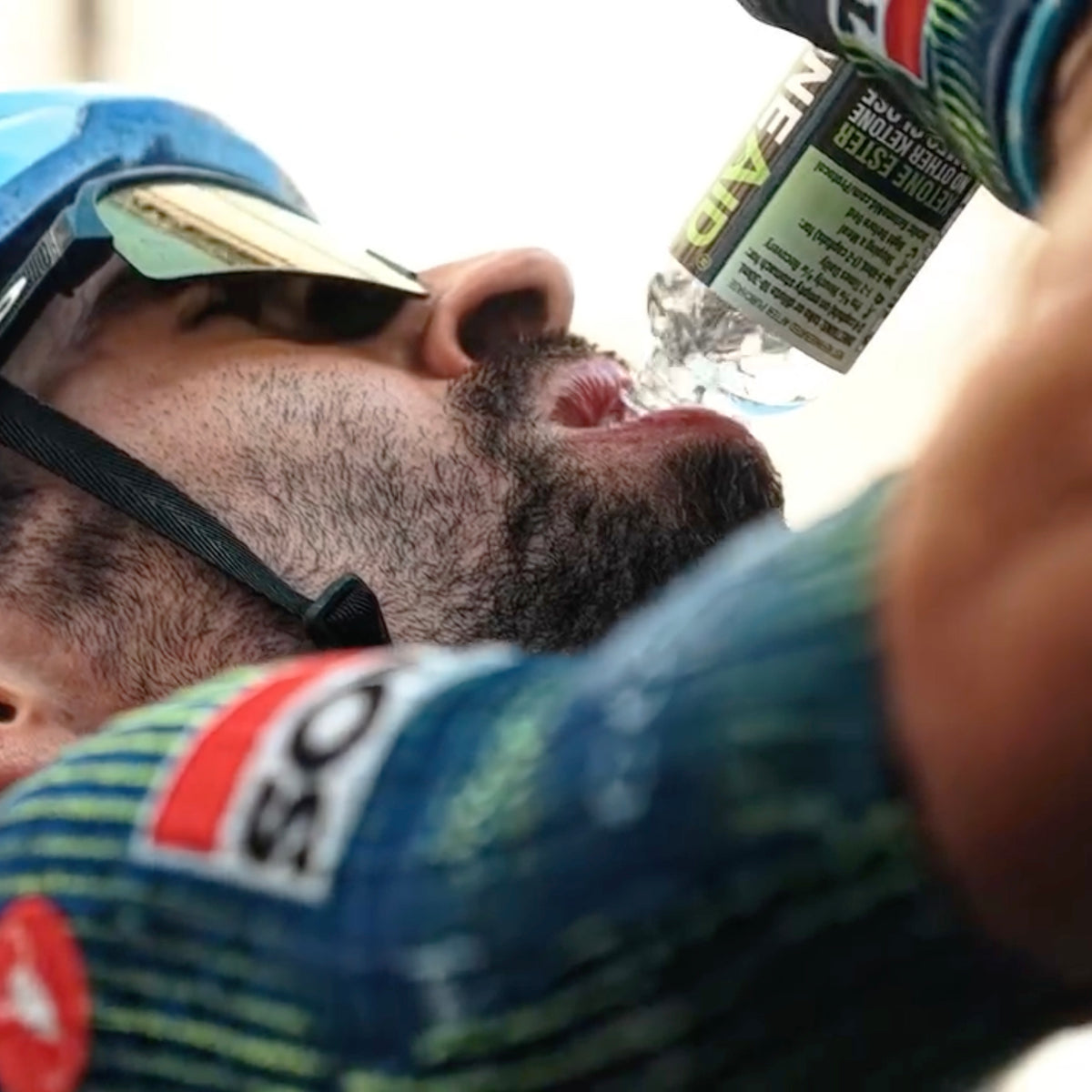
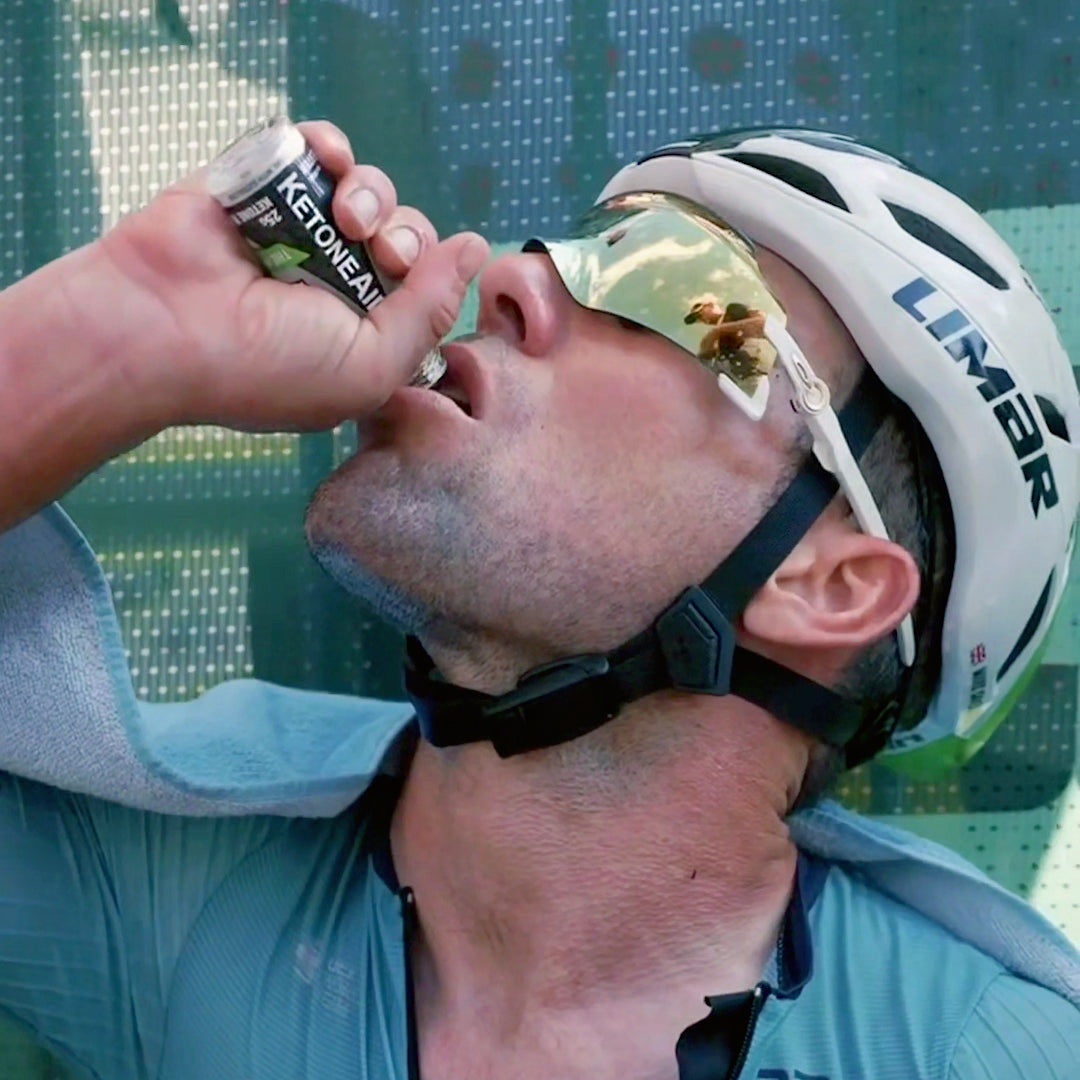
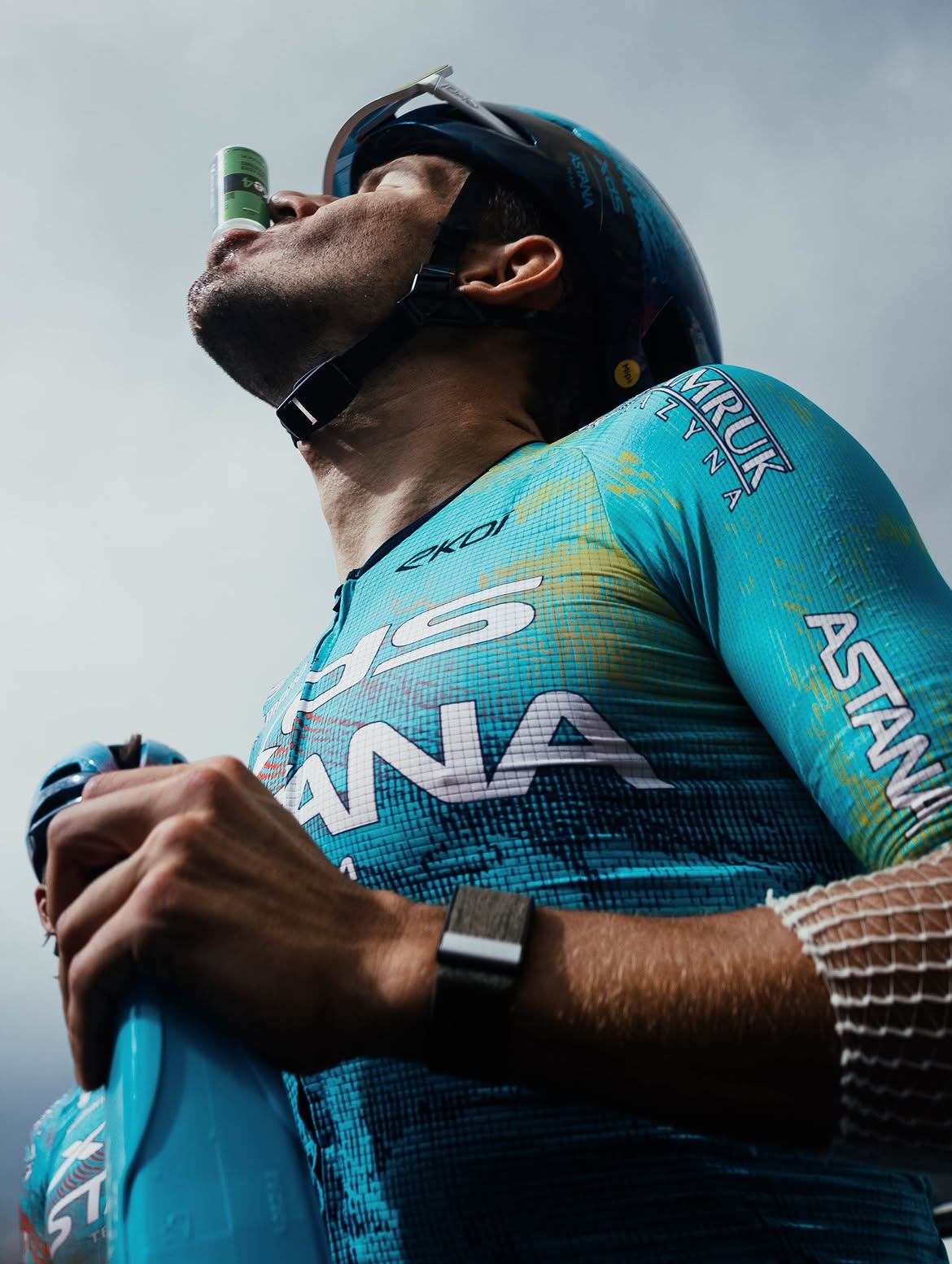
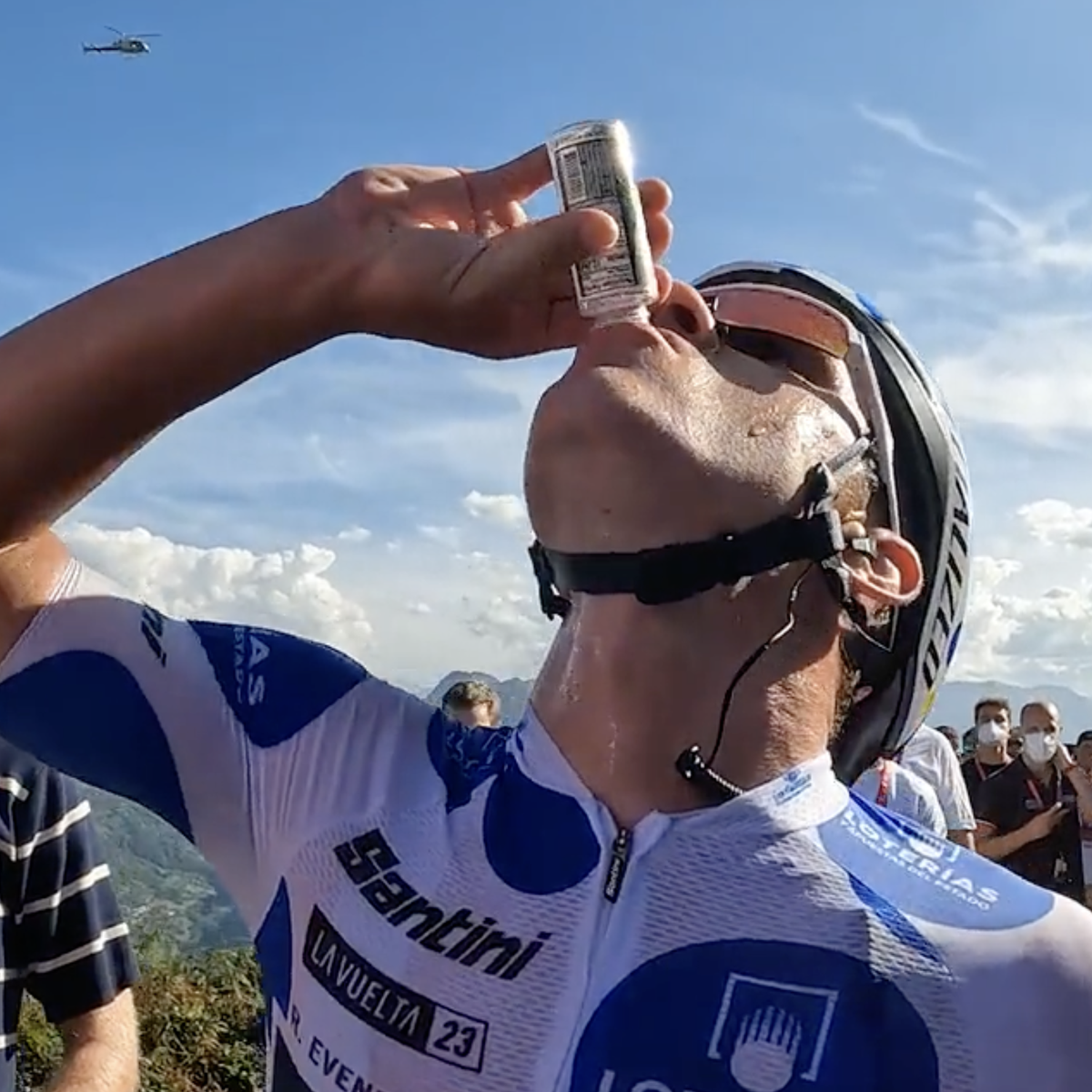
This isn't scientific evidence. It's real world proof from those who have done their homework.
Three human cycling trials show why protocol matters. Cox and Poffé found benefits after prolonged work; the WorldTour study found a 3.1% benefit in the opening 8-minute effort of a much longer stage simulation.
The original Oxford work, in elite athletes, with the ester taken alongside carbohydrate after 60 minutes at 75% of peak power.
Bicarbonate is the buffer your blood uses to soak up acid — the same compound as baking soda, and a long-standing endurance supplement in its own right. Neither ingredient worked without the other.
Monoester with bicarbonate, in actual professional riders rather than recreational athletes.
Prevent mental fatigue. During long efforts, when your focus begins to fade and you drift off pace without noticing, VKE brings you back.
17 endurance-trained males, 90 minutes of loaded treadmill work at 34°C, then a high-intensity test to exhaustion. The 1-back task asks you to track a running sequence while still working — the kind of attention a long effort demands. Both conditions also contained caffeine, so the study tested VKE + caffeine versus carbohydrate + caffeine, not VKE alone.
Accuracy still slipped — it just slipped a lot less. Holding your level as the effort bites is the realistic goal.

By far the best effect is increased endurance.— ISABELLE RUNOLFSDOTTIR, VERIFIED CUSTOMER
I am a 65 year old cyclist and this is absolutely amazing!! It increases focus which is a big part of performance, but on longer climbs and rides, I feel fresher and have power and energy in reserve. I also noticed that my legs need less recovery time. Substantially less.— TONY GILLILAND
Used for 70.3. Kept me constant, didn't run low on energy, combined with carbs.— S C., HALF IRONMAN
This is a very good product for cycling, with very good results for a long day race, it also help me to increase my vo2 max, very good for recovery after a race and also very good recovery for next day race…— DARIEN
CUSTOMER TESTIMONIALS. INDIVIDUAL EXPERIENCES VARY AND ARE NOT RESEARCH OUTCOMES.
Fat-adapted athletes can hit a ceiling: at higher intensities, fat oxidation alone may not supply energy quickly enough to sustain output — and athletes deliberately restricting carbohydrate may not want to add carbohydrate simply to increase available fuel. D-BHB is the third option: another oxidizable substrate that adds no carbohydrate.
100 MILES IN UNDER 24 HOURS · NO CARBOHYDRATE
Emil ran 100 miles in under 24 hours taking no carbohydrate at all — only Veech Ketone Ester and electrolytes. It demonstrates that a very long endurance effort can be completed using a deliberately carbohydrate-free strategy that includes VKE — but it does not establish that carbohydrate is unnecessary for endurance athletes generally. Endogenous glycogen and body fat were still supplying energy throughout.
PODCAST INTERVIEW — LINK PENDING
2× USA ULTRA RUNNING CHAMPION · USATF 50-MILE AND 100K
Kunkel has built a career on low-carbohydrate endurance, and is one of the sport's most-studied practitioners of it. Fat-adapted racing is exactly the setting where a second fast fuel earns its place — the intensity ceiling that fat alone imposes is the whole problem.
PICTURED ABOVE
The same molecule, in the same lab, has produced a 5% gain and a 1.5% loss. That isn't a contradiction — it's the clearest evidence there is that protocol decides the outcome. Here's what the trials actually teach.
The acute gains came in prolonged events — after an hour of steady work, at the end of three hours, or across a simulated stage. Duration of the event matters more than where in it you measure.
COX 2016 · POFFÉ 2021 · IJSNEM 2024
In a high-intensity 30-minute cycling time trial performed with blood D-BHB around 3–4 mM, mean power was about 1.5% lower in the ketone conditions. Neutralizing the acid-base disturbance with bicarbonate did not rescue it.
POFFÉ, WYNS ET AL. 2021 · PMID 33196605
The ester transiently lowers blood pH and bicarbonate. Replacing that buffer is what turned a null result into a 5% power gain in one trial. We're reporting what the research did, not recommending you add bicarbonate — it has its own tolerance issues and belongs in a conversation with your coach.
POFFÉ ET AL. 2021 · PMID 32735112
This is the single most common mistake. Taste, volume and GI response are individual, and race day is the worst possible moment to discover yours. Train with it first, every time.
This is our actual recommendation, and where the evidence is strongest: after sessions and before sleep, week after week. The next section is why.
SEE THE LONG GAME BELOW
Larger doses mean a larger acid load, more GI risk, and in the short-TT study, worse performance. The failed protocols in the literature are mostly big single doses at the wrong moment.
Most endurance supplements are evaluated as race-day aids. VKE is unusual because some of its strongest evidence comes from what happens after training and across repeated training blocks.
A single session is a stimulus. What you become is built from how much quality work you absorb and how much of it converts into adaptation. This is the part of the research nobody markets, and it's the part we'd stake the company on.
In all of those protocols VKE was taken after training and before sleep — not as a pre-workout. The gains showed up in what the training built, not in how the session felt.
Fuel the session. Then let it build the athlete.
“Exogenous ketones” is a category, but different ketones have different results. Monoesters, diesters, salts and precursors reach very different blood D-BHB levels — yet headlines and reviews routinely average them together. VKE has its own negative protocol, documented above. What it doesn't have is a substitute's evidence base.
In a 2019 trial using racemic R,S-1,3-butanediol — a precursor, and a different preparation from current commercial products — blood D-BHB reached only about 0.44–0.79 mM during exercise, a fraction of what the ester produces. Five of nine participants reported moderate to severe GI symptoms.
The famous “ketones made cyclists slower” study. Professional riders were about 2% slower over 31km, with frequent and severe GI distress. A different molecule, and the published commentary attributes the decrement to the GI distress rather than to ketosis.
At a matched dose, salts peaked at 1.0 mM against the ester's 2.8 mM, and arrive roughly half as the L-BHB isoform the body handles poorly.
The molecule in Cox 2016, both Poffé 2021 trials, the overload studies, the eight-week training study and the WorldTour work. When people cite “the ketone research”, this is the research they are citing.
Pooled analyses that average these together tell you about the average of four different things. They don't tell you about any of them.
Where the last hour decides it and carbohydrate alone has stopped being enough.
When tomorrow's performance depends on how well tonight goes.
Train hard, repair stronger, go again. Week after week.
An oxidizable fuel that adds no carbohydrate.
Less concentrated tastes better.
Overwhelmingly positive results. The null and negative outcomes are cautionary protocol tales, and they're here because they're the ones that teach you how to use it.
Elite athletes: about 2% further in a 30-minute time trial.
Cox et al. 2016 · Cell Metabolism · University of Oxford
Elite athletes · ester taken with carbohydrate
PROTOCOL The foundational human performance study on the monoester. Athletes completed a 30-minute time trial after 60 minutes at 75% of peak power, having ingested the ketone ester alongside carbohydrate.
CONTEXT: Small elite sample under laboratory conditions, and later work has not always reproduced it in different protocols — which is the argument of this page rather than an objection to it. PMID 27475046 — PubMed
End of a 3-hour race: 5% higher mean power — but only with bicarbonate.
Poffé et al. 2021 · MSSE 53(2):431–441 · KU Leuven
9 well-trained cyclists · four conditions
PROTOCOL Double-blind randomized crossover. Nine well-trained male cyclists completed a 3-hour intermittent simulated race, a 15-minute time trial and an all-out sprint, taking 60g of carbohydrate per hour throughout. Four conditions: placebo, ketone ester, bicarbonate, or ketone ester plus bicarbonate.
CONTEXT: Nine trained male cyclists. The benefit appeared when blood ketone levels had already fallen back toward baseline, so the authors are careful about attributing it to ketones alone. Bicarbonate supplementation has its own tolerance considerations. PMID 32735112 — PubMed
WorldTour professionals: improved power in the opening phase of a simulated stage.
IJSNEM 2024;34(1) · WorldTour cyclists
Ketone monoester with bicarbonate co-ingestion
PROTOCOL Professional WorldTour cyclists completed a simulated road-cycling stage with repeated time-trial efforts, receiving ketone monoester with bicarbonate or placebo.
CONTEXT: Small professional sample. Benefits were not seen in the later repeated efforts, and the bicarbonate is part of what was tested. International Journal of Sport Nutrition and Exercise Metabolism, 2024;34(1).
The warning: in a short flat-out time trial, ketosis reduced power by about 1.5%.
Poffé, Wyns et al. 2021 · MSSE 53(5):1068–1078
Well-trained cyclists · 30-min TT with and without bicarbonate
PROTOCOL The same group testing whether raising blood ketones helps when the acid load is neutralised. A 60-minute warm-up at low-to-moderate intensity including several harder efforts, then a 30-minute simulated time trial and an all-out sprint, under placebo, ketone ester, bicarbonate, or both.
CONTEXT: Well-trained male cyclists. Read alongside the 3-hour study rather than instead of it — together they define the window where acute use makes sense. PMID 33196605 — PubMed
Eight weeks: greater aerobic gains than the same training alone.
Robberechts et al. 2026 · Journal of Physiology
28 trained males · post-exercise and pre-sleep dosing
PROTOCOL Twenty-eight trained males completed eight weeks of supervised cycling. Fourteen took 25g of the monoester immediately after each session and again before sleep; fourteen took an isocaloric placebo.
CONTEXT: Trained males only, 14 per group, supervised laboratory programme. Journal of Physiology, doi 10.1113/JP290315.
Overload block: 15% more late-session power and 15% more sustainable training load.
Poffé et al. 2019 · Journal of Physiology
18 fit males · 3 weeks, two sessions daily
PROTOCOL Three weeks of deliberately excessive cycling designed to induce non-functional overreaching. Nine received a ketone ester after each session and before sleep; nine received a control drink.
CONTEXT: Nine per group, fit males, a load built to cause overreaching. Part of the effect may relate to the difference in energy balance between groups. PMID 31039280 — PubMed
Overload block: capillary contacts up 44%, circulating EPO up about 25%.
Poffé et al. 2023 · Journal of Physiology
18 fit males · muscle biopsies
PROTOCOL Three weeks of endurance overload at ten sessions per week. Nine received 25g of ketone ester after each session and 30 minutes before sleep; nine received an isocaloric control. Vastus lateralis biopsies before and after.
CONTEXT: Nine per group, fit males. Measures of muscle capillarisation and circulating EPO, not clinical outcomes. PMID 37062892 — PubMed
Other molecules: the diester decrement, and the butanediol that barely raised ketones.
Leckey et al. 2017 · Shaw et al. 2019
Not the Veech monoester
PROTOCOL Leckey and colleagues gave ten elite male cyclists a 1,3-butanediol acetoacetate diester at 250mg per kg before a ~31km simulated championship time trial. Shaw and colleagues used racemic R,S-1,3-butanediol, a ketone precursor rather than an ester, and a different preparation from current commercial butanediol products.
CONTEXT: We include these because they are the studies most often cited against ketones, and because the molecule distinction only counts for something if we're willing to show the papers. Leckey PMID 29109686 — PubMed
Veech Ketone Ester is a food. Nothing on this page is intended to diagnose, treat, cure or prevent any disease, and nothing here is medical advice. Research findings described here are measured outcomes from controlled trials in specific participant groups under specific protocols, not expected results for any individual. Bicarbonate co-ingestion has its own tolerance considerations and is not part of our standard recommendation. Our Veech Ketone Ester molecule is manufactured in the United States.
Yes, under the right conditions.
Ketone ester improved 30-minute time-trial performance by about 2% in elite athletes, raised mean power 5% at the end of a 3-hour race when paired with bicarbonate, and improved opening-phase power in WorldTour professionals.
The conditions that matter are effort length and dose. Long or late efforts respond. Short flat-out efforts don't, and can go the other way.
Then it keeps improving. Eight weeks of training with it produced an additional 6% VO2peak gain over the same training alone — which is a bigger number than anything a single bottle will do.
Possibly, depending on the event and the protocol.
Positive acute studies have used different conditions, and some of the strongest results involved co-ingestion with carbohydrate or bicarbonate. Bicarbonate has its own dosing and tolerance considerations, so we don't recommend adding it solely from reading one study.
In a high-intensity 30-minute time trial, mean power was about 1.5% lower in the ketone conditions — so short, hard efforts are the weakest case.
Never use VKE for the first time on race day. Taste, volume and individual GI response need to be sorted in training, not at the start line.
No, and this is where most bad experiences come from.
Bigger doses mean a bigger acid load, more GI risk and no extra benefit. The failed protocols in the literature are largely big single doses at the wrong moment in the wrong kind of effort.
Our protocols page has amounts by use case.
Because they asked different questions, and a few of them asked about a different molecule.
The monoester trials themselves produced positive, null and negative results depending on exercise protocol, dosing, carbohydrate intake and acid-base conditions. That isn't contradiction, it's dose-response and context.
Reviews that average all of it together — including 1,3-butanediol trials that reached under 1 mM of D-BHB — produce a headline that describes none of the individual studies.
Yes, and it's one of the more interesting uses.
Fat-adapted athletes can hit a ceiling because at higher intensities fat oxidation alone may not supply energy quickly enough. D-BHB is another oxidizable substrate that adds no carbohydrate.
Emil Igersalv ran 100 miles in under 24 hours on VKE and electrolytes alone, with no carbohydrate at all.
Mostly for recovery between stages, which is exactly where the strongest evidence sits.
A grand tour is the recover-and-repeat problem in its purest form: perform, recover, do it again tomorrow, twenty-one times. KetoneAid supplies and advises Soudal Quick-Step and XDS Astana.
“Exogenous ketones” is a category, but different ketones have different results.
Studies have tested ketone monoesters, other esters, ketone salts and ketone precursors, with different blood D-BHB responses and different results. The endurance evidence has to be interpreted molecule by molecule.
The strongest direct human endurance and training-adaptation evidence is for the Veech Ketone Ester.
Don't ask whether ketones were studied. Ask which ketone was studied.
The Cox et al. 2016 study used the Veech Ketone Ester — the D-BHB ketone monoester — alongside carbohydrate.
It did not test R 1,3 butanediol, ketone salts or an acetoacetate diester. Athletes completed an hour of steady work before a 30-minute time trial and travelled about 2% farther in the ketone-ester condition.
Worth knowing, because that study is widely cited when discussing products that don't contain the molecule it tested.
Not necessarily.
Some of the strongest acute VKE performance results were produced alongside carbohydrate, not instead of it. Cox 2016 used both. The 3-hour race protocol had riders taking 60g of carbohydrate per hour throughout.
VKE provides another oxidizable fuel substrate. That doesn't mean carbohydrate becomes unnecessary for every athlete or every event.
Carb-free racing is a separate use case, and a real one — particularly for athletes deliberately training or racing with low carbohydrate availability.
All three are the same Veech Ketone Ester at different dilutions, so the choice is about concentration, taste and how you want to dose.
Ke4 is 50% and carries 30g per bottle — the most ester in the fewest bottles, and the most potent taste. Ke2 is 25% with 25g per bottle: three times the water of Ke4 at the same cost per gram, and easier to get down. The Ketone Shot is 8% with 5g per bottle, ready to drink with nothing to measure.
For daily use through a training block, most athletes end up on Ke4 or Ke2 on cost per gram.
This page covers what the research shows across endurance generally. Sport-specific protocols get their own pages.


