

Go deeper. Stay sharper.
Recover for the next one.
Focus. Energy. Recovery.
Veech Ketone Ester gives runners another fuel source, helps preserve mental performance deep into long efforts, and has human evidence for endurance training adaptation and recovery.
Direct runner studies show the strongest signal in long-duration efforts, while broader endurance research points to benefits across training and recovery.
More left when the miles
start taking something away.
locked in
Support reaction, judgement, pacing, fueling decisions and technical execution deep into long efforts.
source
VKE raises D-BHB directly, giving the body another usable fuel alongside carbohydrate.
ready
Support recovery, sleep and the ability to absorb repeated endurance work.
What the runner studies
actually show.
Stay sharp deep into the run.
REACTION + MOVEMENT DECLINE PREVENTED WITH VKE
In the control group, visual reaction and movement execution slowed across the ultra-distance effort. With VKE, that deterioration was prevented.
~2× circulating dopamine during the run.
POFFÉ ET AL. 2023 · J APPL PHYSIOL · PMID 37141424
Same pace. Less oxygen.
BETTER RUNNING ECONOMY IN ONE DIRECT RUNNER TRIAL
At the same submaximal speeds, runners used less oxygen with VKE in one crossover study.
A later study did not reproduce the economy result.
BRADY & EGAN 2024 · MSSE 56(1):134–142 · PMID 37565450
Sharper after 31 days.
FASTER COGNITIVE RESPONSES IN RUNNERS
A 31-day runner trial did not improve 5K time, but did improve response speed on cognitive tasks and changed exercise physiology.
PRINS ET AL. 2026 · PMID 41773904
When the body fades,
keep your head in the race.
Eighteen recreational runners set out on a 60–100km trail effort. Eight completed 100km, six stopped at 80km, four stopped at 60km. Nine took Veech Ketone Ester, nine took control. Blood D-BHB ran about 2–3mM with VKE against under 0.3mM in control.
LONG-DURATION TRAIL RUNNING
18 recreational runners. Nine took VKE, nine took control.
DECLINE SEEN IN CONTROL WAS PREVENTED
EXECUTION DECLINE SEEN IN CONTROL WAS PREVENTED
CIRCULATING DOPAMINE
The important result wasn't “superhuman reaction time.” It was preserving mental performance when extreme duration would normally start degrading it.
Post-run muscle markers also pointed to improved muscular energy status and recovery signalling.
The study used a large supervised research protocol. RESEARCH DOSE — NOT CONSUMER INSTRUCTIONS Exact amounts are in the research section below.
POFFÉ ET AL. 2023 · JOURNAL OF APPLIED PHYSIOLOGY · PMID 37141424 · PUBMED
Not just the lab.
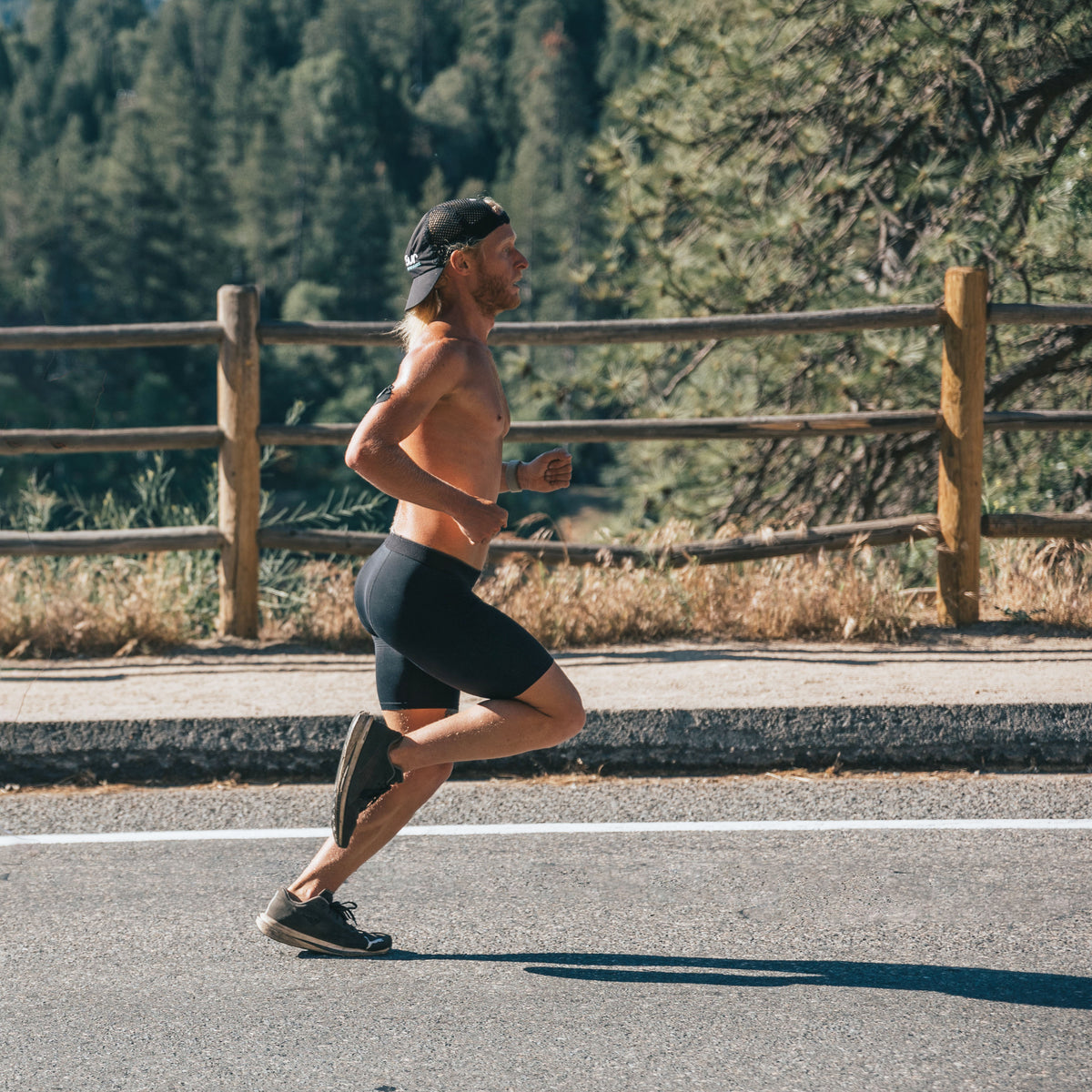
2× NATIONAL CHAMPION ULTRA-DISTANCE RUNNER · KETONEAID USER
Wow…I barely trained for my recent half marathon and ended up breaking my PR from 11 years ago when I called myself a runner. I was so focused the whole race. The energy never stopped coming.— JOHN FERRARO
Used for 70.3. Kept me constant, didn't run low on energy, combined with carbs.— S C., HALF IRONMAN
By far the best effect is increased endurance.— ISABELLE RUNOLFSDOTTIR
Same pace.
Less oxygen.
BETTER RUNNING ECONOMY IN A DIRECT RUNNER TRIAL
Eleven male middle- and long-distance runners held the same submaximal speeds using measurably less oxygen when they took the Veech Ketone Ester without carbohydrate.
That's what running economy means: the oxygen cost of holding a given pace. Improve it and the same pace costs you less.
BRADY & EGAN 2024 · MSSE 56(1):134–142 · PMID 37565450 — THE RUNNING-ECONOMY PAPER
Protocol and fuel context matter — the 2024 result came without carbohydrate, and the 2025 follow-up used a different dose and design and did not reproduce the effect. Both papers are in the research section below.
Use VKE for the problem
you're actually trying to solve.
Stay sharper when fatigue gets deep.
Support adaptation and recovery across repeated work.
Test the exact amount, timing and fueling strategy in training first.
Weeks of training.
Not just race morning.
The strongest endurance results came when athletes used VKE repeatedly through hard training blocks — for 3 to 8 weeks — rather than treating it as a one-time pre-race product.
12% VS 6% · PLUS ~4% HIGHER 30-MINUTE TT POWER
+15% LATE-SESSION POWER · +15% SUSTAINABLE TRAINING LOAD
MORE MITOCHONDRIAL MACHINERY · CAPILLARY ADAPTATION · BETTER SLEEP AFTER HARD TRAINING
For a serious event, the better question may not be “When do I take it on race day?” It may be “How do I build it into the weeks that get me there?”
*These training-block studies were performed in trained cyclists, not runners.

Build more from the work
you're already doing.
The strongest repeated-use VKE studies weren't one-off race-day tests. Athletes used it across hard training blocks — and the gains showed up in aerobic fitness, late-session output and recovery.
VO2peak gain*
12% VS 6% AFTER 8 WEEKS
in hard training*
+15% LATE-SESSION POWER · +15% SUSTAINABLE TRAINING LOAD
machinery*
+14% CITRATE SYNTHASE · +25% OXPHOS COMPLEX II
hard training*
~90% OF EXERCISE-INDUCED EXTRA NIGHT WAKEFULNESS REVERSED
*Human endurance studies in trained cyclists, not direct runner trials.
25Yr Sub 3 Marathoner keeps
streak alive with VKE.
CHRIS FARLEY · CHIEF RUNNING ENTHUSIAST, PACERS RUNNING
It wasn't until he missed his target of 25 years of running sub 3 hour marathons, that he decided to take a 2 week trial of KetoneAid Ketone Ester seriously. It worked. He beat his time by several minutes and noticed a huge improvement, and the funny thing was he didn't use ketone ester right before or during the race! It was only used 2 weeks before. Chris' comeback story, to which he credits Frank and KetoneAid, was subsequently picked up by the Washington Post as an inspirational underdog story, twice.
WATCH THE FULL CHRIS FARLEY PODCAST
REAL-WORLD CASE STUDY · INDIVIDUAL EXPERIENCE, NOT A CONTROLLED TRIAL
Four practical strategies — not one prescription. Research doses are not our consumer instructions.
Support focus and fuel across the distance
This is where the direct runner evidence is strongest. Test amount, timing, fueling and gut tolerance in training before using VKE in a long event.
RESEARCH DOSES ARE NOT CONSUMER INSTRUCTIONS.
Use VKE alongside your fueling plan
VKE is an additional fuel, not a carbohydrate replacement. Conventional high-output marathon racing still relies heavily on carbohydrate. Test the exact pairing in training before race day.
Train with it, not just race with it
The strongest repeated-use adaptation evidence comes from endurance athletes taking VKE after training and before sleep. That work was done in cyclists, but it's the clearest reason to test VKE across a block rather than only on race morning.
Think training support, not race-morning speed
Direct 5K and 10K trials did not show a race-time benefit. For shorter distances the stronger case is training support, recovery and cognitive support under fatigue.
A natural fit for fat-adapted runners
For runners already training low-carb or fat-adapted, VKE can fit naturally into an already lower-glucose fuel environment. In that context ketones may play a larger role, because they aren't competing with a heavy carbohydrate strategy.
A REAL-WORLD USE CASE SUPPORTED BY STRONG ANECDOTAL EXPERIENCE, NOT A DEDICATED DIRECT RUNNER TRIAL.
Questions about your event or protocol?
Tell us the distance, terrain, training phase and what you're trying to solve. We'll point you toward the relevant research and protocol.

No other ketone
comes close.
Every runner study cited on this page used the Veech Ketone Ester — the D-BHB ketone monoester. That matters more than the word “ketone” on a label.
R 1,3 butanediol, ketone salts, D-BHB free acid, mixtures of D-BHB and R 1,3 butanediol, and other ketone esters are different molecules or formulations. They do not inherit these results.
Some ketone brands cite Veech Ketone Ester studies while selling a different molecule. Those products do not inherit these results.
Check the molecule, not just the claim.
Ketone ester does not always mean Veech Ketone Ester. The bond is key.
Go deeper. Stay sharper.
Recover for the next one.
The strongest training-adaptation result on this page came from repeated VKE use over eight weeks — after training and before sleep. That study was in trained cyclists, not runners, but it gives endurance athletes a clear reason to test VKE as a block rather than a one-off race-day dose.
Buy enough to actually run the block.
The running research.
Direct runner studies first — positive, null and mixed. Adjacent endurance evidence is labelled separately and never presented as runner-specific.
DIRECT RUNNER STUDIES
60–100km trail running: the decline in reaction and movement execution seen in control was negated.
Poffé et al. 2023 · Journal of Applied Physiology
18 recreational runners · 9 VKE / 9 control · PMID 37141424
Poffé et al. 2023 · Journal of Applied Physiology
18 recreational runners · 9 VKE / 9 control · PMID 37141424
PROTOCOL Eighteen recreational runners attempted 60–100km on trail. Eight completed 100km, six stopped at 80km, four at 60km. The ketone group received 25g before the run, 25g per hour during it, then five further 25g servings over the next 24 hours. Blood D-BHB ran about 2–3mM against under 0.3mM in control.
WHAT HAPPENED
- Visual reaction time in control went from 353ms to 419ms across the effort. That deterioration was fully negated with VKE.
- Movement execution time in control went from 174ms to 245ms. Also fully negated.
- Plasma dopamine roughly doubled during the run, 4.1 against 2.4nM after it.
- Post-run muscle markers differed, including lower macrophage infiltration and suppressed AMPK phosphorylation out to 36 hours.
WHY IT MATTERS
- This is the strongest direct runner-specific result that exists, and it is about cognition rather than speed.
- The finding is preservation, not enhancement: control got worse and VKE did not.
- The authors read the muscle markers as improved muscular energy status during recovery.
CONTEXT: Recreational runners, nine per group, and a research dosing protocol far larger than anything we recommend. No finishing-time claim is made or implied. PMID 37141424, doi 10.1152/japplphysiol.00791.2022 — PubMed
Running economy: 4.1% better with the monoester, but only without carbohydrate.
Brady & Egan 2024 · MSSE 56(1):134–142
11 male middle- and long-distance runners · PMID 37565450
Brady & Egan 2024 · MSSE 56(1):134–142
11 male middle- and long-distance runners · PMID 37565450
PROTOCOL Placebo-controlled randomized crossover, three conditions: a 10% carbohydrate solution; the same carbohydrate solution with 750mg per kg of the ketone monoester; or 750mg per kg of the monoester in flavoured water. Five 8-minute submaximal treadmill stages at 10–14 km/h, then a ramp test to exhaustion.
WHAT HAPPENED
- The monoester without carbohydrate reduced the oxygen cost of submaximal running by an average of 4.1%.
- The monoester with carbohydrate did not improve economy.
- Time to exhaustion on the ramp test was unchanged.
WHY IT MATTERS
- Fuel context changed the result within the same group of runners.
- Running economy is a measure of oxygen cost at a given speed. It is not race time, and this study did not measure one.
CONTEXT: Eleven male runners, acute laboratory protocol. Read alongside the 2025 follow-up below rather than on its own. PMID 37565450, doi 10.1249/MSS.0000000000003278 — PubMed
The follow-up: advanced footwear improved running economy. The monoester did not.
Brady et al. 2025 · MSSE 57(7):1559–1569
18 runners, 10 male / 8 female · PMID 39999362
Brady et al. 2025 · MSSE 57(7):1559–1569
18 runners, 10 male / 8 female · PMID 39999362
PROTOCOL Four-condition placebo-controlled randomized crossover in 18 middle- and long-distance runners, testing advanced footwear technology and acute monoester ingestion separately and together. Five 8-minute submaximal stages, then a ramp test to exhaustion. 500mg per kg of the monoester 20 minutes before exercise.
WHAT HAPPENED
- Advanced footwear improved running economy.
- Acute monoester ingestion did not.
WHY IT MATTERS
- It is the direct follow-up to the 2024 result, from the same research group, and it did not reproduce the economy advantage.
- The dose and fuel context both differed from the 2024 protocol, which is the argument of this page.
CONTEXT: Ten men and eight women, acute protocol. Included because a page arguing that protocol decides the outcome has to show the protocols that didn't work. PMID 39999362, doi 10.1249/MSS.0000000000003682 — PubMed
10km: no benefit on running performance.
Evans, McSwiney, Brady & Egan 2019 · MSSE 51(12):2506–2515
Trained middle- and long-distance runners · PMID 31730565
Evans, McSwiney, Brady & Egan 2019 · MSSE 51(12):2506–2515
Trained middle- and long-distance runners · PMID 31730565
PROTOCOL Trained middle- and long-distance runners completed an hour of treadmill running at roughly 65% VO2max with carbohydrate plus either placebo or the ketone monoester, followed by a 10km time trial.
WHAT HAPPENED
- No significant benefit on 10km performance.
- Blood beta-hydroxybutyrate rose as expected; the performance endpoint did not move.
WHY IT MATTERS
- It is the clearest direct evidence against a short-race speed claim in runners.
- The monoester was co-ingested with carbohydrate, which the 2024 economy study later showed changes the result.
CONTEXT: Small trained sample, acute protocol. PMID 31730565, doi 10.1249/MSS.0000000000002065 — PubMed
31 days of high-dose monoester: no 5km improvement, though some cognitive and physiological measures changed.
Prins et al. 2026
Recreational runners · PMID 41773904
Prins et al. 2026
Recreational runners · PMID 41773904
PROTOCOL A 31-day high-dose ketone monoester trial in recreational runners, testing 5km performance alongside cognitive and physiological measures.
WHAT HAPPENED
- 5km performance did not improve.
- Response speed on cognitive tasks improved.
- Some exercise-physiology measures changed.
WHY IT MATTERS
- It tests repeated use rather than an acute dose, and still found no short-race speed benefit.
- It is consistent with the rest of this page: the runner-specific signal is cognitive, not 5km speed.
CONTEXT: Recreational runners, high-dose protocol. PMID 41773904, doi 10.1080/27697061.2026.2636551 — PubMed
HUMAN ENDURANCE EVIDENCE THAT MAPS TO RUNNING — NOT RUNNER-SPECIFIC
Eight weeks of endurance training: +4% time-trial power and greater mitochondrial adaptation.
Robberechts et al. 2026 · Journal of Physiology · cyclists, not runners
28 trained males · PMID 41757674
Robberechts et al. 2026 · Journal of Physiology · cyclists, not runners
28 trained males · PMID 41757674
PROTOCOL Twenty-eight trained males, eight weeks of supervised cycling. Fourteen took 25g of the monoester immediately after each session and again before sleep; fourteen took an isocaloric placebo.
WHAT HAPPENED
- 30-minute time-trial power about 4% higher, 302 against 291 W.
- Relative VO2peak improved 12% against 6% in control.
- Citrate synthase activity 14% higher; OXPHOS complex II protein up 25%.
WHY IT MATTERS
- It is the strongest repeated-use adaptation evidence for the molecule.
- It was done in cyclists. It supports testing VKE across a training block; it is not a runner-specific result.
CONTEXT: Trained males, supervised laboratory programme, cycling. PMID 41757674, doi 10.1113/JP290315 — PubMed
Three-week overload: 15% more late-session power and 15% more sustainable training load.
Poffé et al. 2019 · Journal of Physiology · cyclists, not runners
18 fit males · PMID 31039280
Poffé et al. 2019 · Journal of Physiology · cyclists, not runners
18 fit males · PMID 31039280
PROTOCOL Three weeks of deliberately excessive cycling designed to induce non-functional overreaching. Nine received a ketone ester after each session and before sleep; nine received a control drink.
WHAT HAPPENED
- Power in the final 30 minutes of a standardized 2-hour session was 15% higher.
- Sustainable training load in week 3 was also 15% higher.
- The rise in nocturnal adrenaline and noradrenaline was inhibited.
WHY IT MATTERS
- Absorbing more quality load is the input to adaptation in any endurance sport.
- Cyclists, not runners. Energy balance also differed between groups, which may explain part of the effect.
CONTEXT: Nine per group, fit males, an overload model rather than a normal programme. PMID 31039280, doi 10.1113/JP277831 — PubMed
Overload block: capillary contacts up 44%, serum EPO up about 25%.
Poffé et al. 2023 · Journal of Physiology · cyclists, not runners
18 fit males · muscle biopsies · PMID 37062892
Poffé et al. 2023 · Journal of Physiology · cyclists, not runners
18 fit males · muscle biopsies · PMID 37062892
PROTOCOL Three weeks of endurance overload at ten sessions per week. Nine received 25g of ketone ester after each session and 30 minutes before sleep; nine received an isocaloric control. Vastus lateralis biopsies before and after.
WHAT HAPPENED
- Capillary contacts increased 44% and the capillary-to-fibre exchange index 42%.
- Serum EPO rose about 25% and was unchanged in control.
- VEGF and eNOS also increased in muscle.
WHY IT MATTERS
- Oxygen delivery into working muscle matters to a runner as much as a cyclist.
- Cyclists, not runners. These are measures of muscle capillarisation and circulating EPO, not clinical outcomes, and not comparable to administered erythropoietin.
CONTEXT: Nine per group, fit males, three weeks of deliberate overload. PMID 37062892, doi 10.1113/JP284346 — PubMed
After a hard training day: improved sleep efficiency and most of the extra wakefulness reversed.
Robberechts et al. 2023 · MSSE · cyclists, not runners
10 trained cyclists · polysomnography · PMID 37259248
Robberechts et al. 2023 · MSSE · cyclists, not runners
10 trained cyclists · polysomnography · PMID 37259248
PROTOCOL Ten trained cyclists completed morning endurance work and evening HIIT ending one hour before bedtime, receiving 25g of VKE after exercise and a further 25g thirty minutes before bed, or placebo. Sleep measured by polysomnography.
WHAT HAPPENED
- The training day alone reduced REM sleep 26% and increased wakefulness after sleep onset 95%.
- Sleep efficiency improved 3% with VKE.
- Roughly 90% of the exercise-induced extra wakefulness was reversed.
WHY IT MATTERS
- The night after a long session is a problem runners have too.
- Cyclists, not runners. The research doses were larger than we recommend, and VKE is a food, not a sleep aid.
CONTEXT: Ten trained cyclists and a deliberately disruptive exercise protocol. PMID 37259248 — PubMed
Ketones and running
Does Veech Ketone Ester help runners?
Yes — in specific, measured ways.
Across a 60–100km trail effort, the decline in visual reaction and movement execution seen in control was prevented with VKE, while circulating dopamine roughly doubled. One 2024 trial found about 4.1% better running economy. A 31-day runner trial improved response speed on cognitive tasks.
Broader endurance research supports training adaptation, late-session output and recovery, though that work was done in cyclists rather than runners.
What it has not done is make short races faster: direct 5K and 10K speed trials were null, and one economy study was not reproduced.
What can I take to support running or marathon performance?
It depends on what you're trying to improve.
People searching for “running supplements” are often trying to solve several different problems — energy, endurance, focus, recovery or performance late in a race.
Veech Ketone Ester is a food, not a dietary supplement. It raises D-BHB directly and gives the body another oxidizable fuel rather than simply adding more carbohydrate or acting as a stimulant.
Direct runner research with VKE includes preserved mental performance across a 60–100km effort, a positive running-economy result in one trial, and faster cognitive responses after repeated use. Broader endurance research also points to training-adaptation and recovery applications.
The important part is not simply adding VKE to race morning. The protocol should match the problem you're trying to solve.
How can I improve my running stamina?
“Stamina” can mean several different things: holding pace, using less energy at a given pace, staying mentally sharp, or recovering well enough to keep training.
VKE does not have a universal “makes every runner faster” result. Direct 5K and 10K trials have not shown a reliable race-time benefit.
The more interesting evidence appears elsewhere: mental performance was preserved across a 60–100km trail effort, one direct runner trial found 4.1% better running economy, and broader endurance studies found stronger training adaptation and more late-session output with repeated VKE use.
For many runners, that makes VKE more interesting as something incorporated into long efforts, training and recovery than as a generic pre-race speed shot.
Why do runners hit the wall late in a marathon?
“Hitting the wall” is usually not one single failure. Fuel availability, pacing, heat, hydration and accumulated fatigue can all contribute as the race gets long.
Veech Ketone Ester does not have direct evidence showing that it prevents the marathon wall, and we should not pretend that it does.
What makes VKE relevant is that it provides D-BHB as another oxidizable fuel rather than simply adding more carbohydrate. The direct running and broader endurance research also suggests that duration and fuel context matter considerably.
For a marathoner, the practical question is therefore how VKE fits into the complete fueling and training strategy — and that protocol should be tested before race day.
How can I recover after a marathon or hard race?
VKE's recovery case is broader than simply feeling less sore the next morning.
In the direct ultra-running study, post-run muscle measurements pointed to improved muscular energy status and recovery signaling. The larger repeated-training evidence comes from cyclists, where VKE used around hard training improved late-session output, training adaptation and sleep after strenuous exercise.
That cyclist evidence should not be presented as though it were a direct marathon-recovery trial. But it is highly relevant to the recovery problem runners are trying to solve, especially when another training session or event is coming.
Does ketone ester improve running economy?
One 2024 trial found about 4.1% better running economy with the ketone monoester taken without carbohydrate, in 11 male middle- and long-distance runners.
The benefit was not seen when the monoester was taken with carbohydrate, and a 2025 follow-up in 18 runners did not reproduce an economy benefit at all — although advanced footwear in the same study did.
Running economy is not the same thing as race time. It measures the oxygen cost of running at a given speed, and neither study measured a race.
Does VKE make you faster in a 5K or 10K?
Current direct evidence does not show a reliable 5K or 10K race-time benefit.
That doesn't mean VKE has no role for shorter-distance runners. The stronger case may be training support, recovery, and cognitive support under fatigue rather than an acute race-morning speed effect.
The detail: an acute 10K trial was null, and a 31-day trial did not improve 5K time — though response speed on cognitive tasks improved and some physiological measures changed.
Can VKE help during ultramarathons?
This is where the direct runner evidence is strongest.
In a 60–100km trail protocol, visual reaction time in control rose from 353ms to 419ms and movement execution from 174ms to 245ms across the effort. Both deteriorations were fully negated with VKE, and plasma dopamine roughly doubled.
The result is preserved mental performance under extreme duration. It is not a faster finishing time, and that study did not measure one. The research dosing was far larger than anything we recommend.
Do ketones replace carbohydrates for marathon running?
No — and “replacement” is probably the wrong question.
Carbohydrate is the traditional fuel for high-output marathon running. Veech Ketone Ester adds another oxidizable fuel — D-BHB — through a different metabolic pathway.
The direct runner research shows why context matters. One running-economy study found a positive result when VKE was taken without carbohydrate, but not when carbohydrate was taken alongside it. A later study using a different protocol did not reproduce the economy benefit.
So the question is not simply whether ketones replace carbs. It is how VKE fits into the particular run, training block, recovery window and fueling strategy you're trying to improve.
When should runners take VKE?
It depends on the objective. Long-event use, training-block use and race-morning use are three different questions with three different bodies of evidence.
Whatever you're testing, test it in training first — amount, timing, carbohydrate pairing and gut tolerance. Don't copy research doses, and don't introduce anything new on race day.
Is VKE banned by WADA?
Veech Ketone Ester is not prohibited under WADA rules, and selected KetoneAid products are independently batch tested for substances prohibited under anti-doping rules.
WADA does not certify or endorse products. No product eliminates an athlete's individual anti-doping responsibility. Check current batch documentation for the specific product you intend to use.
Which KetoneAid format should I choose?
All three are the same Veech Ketone Ester at different dilutions, so the choice is about concentration, taste and how you want to dose.
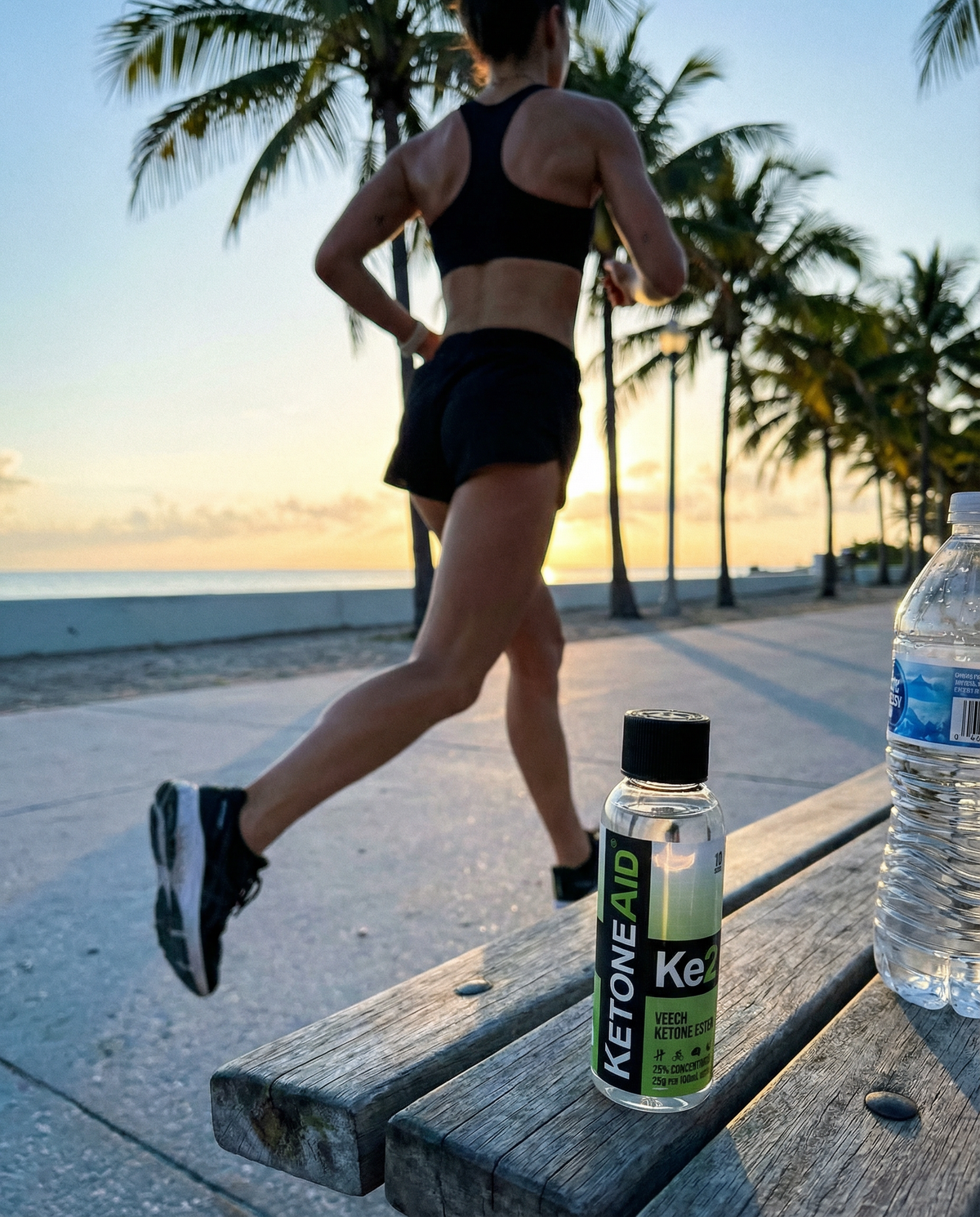
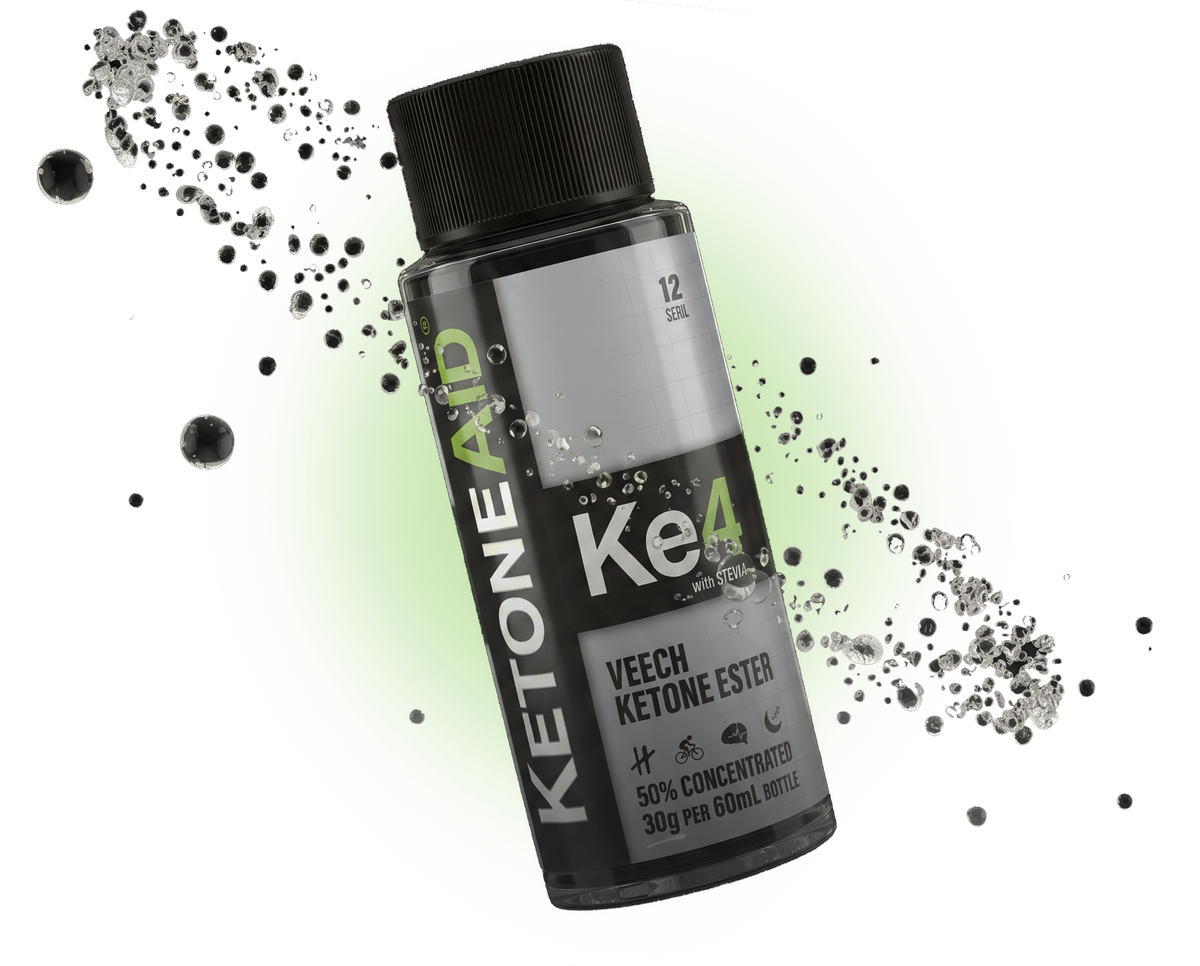
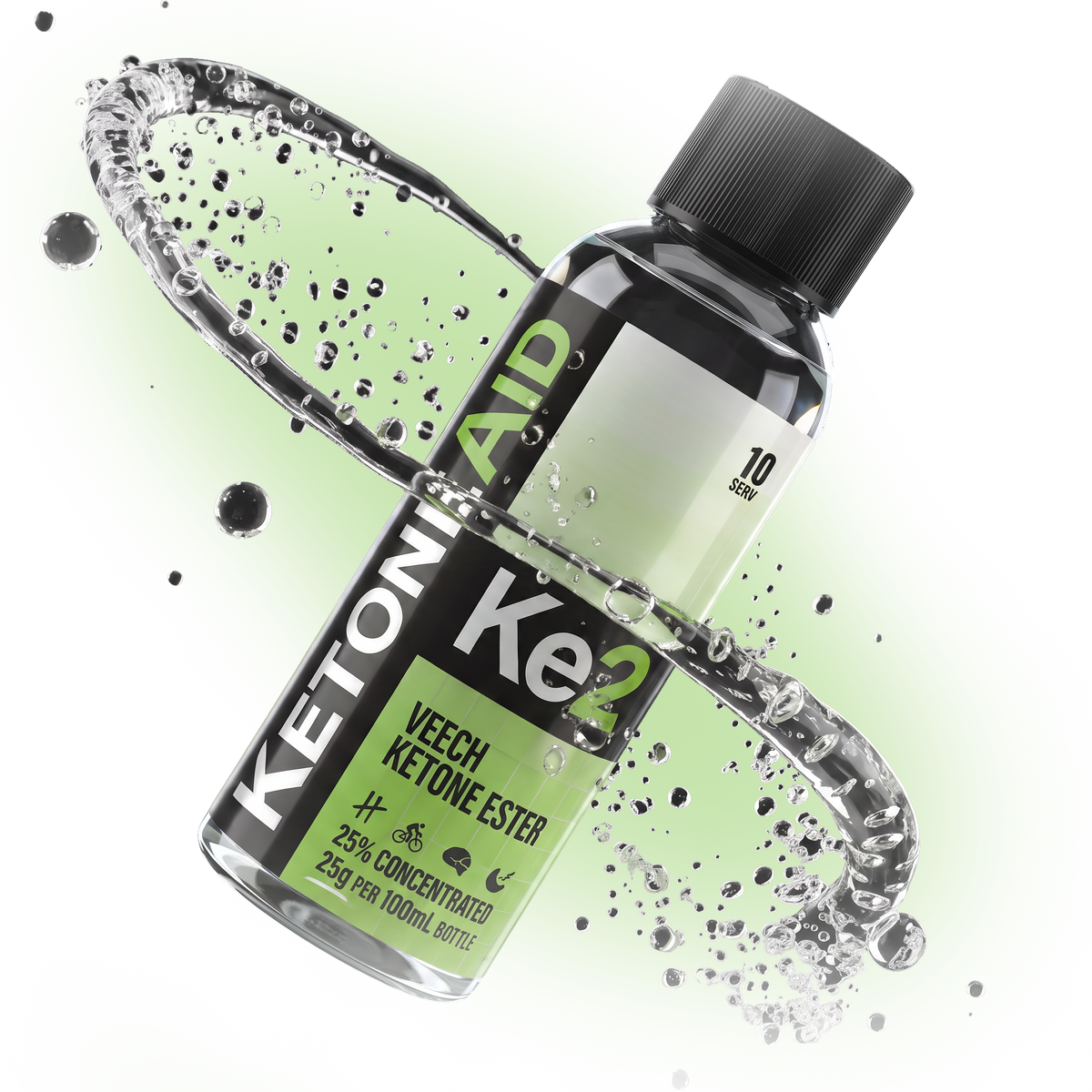
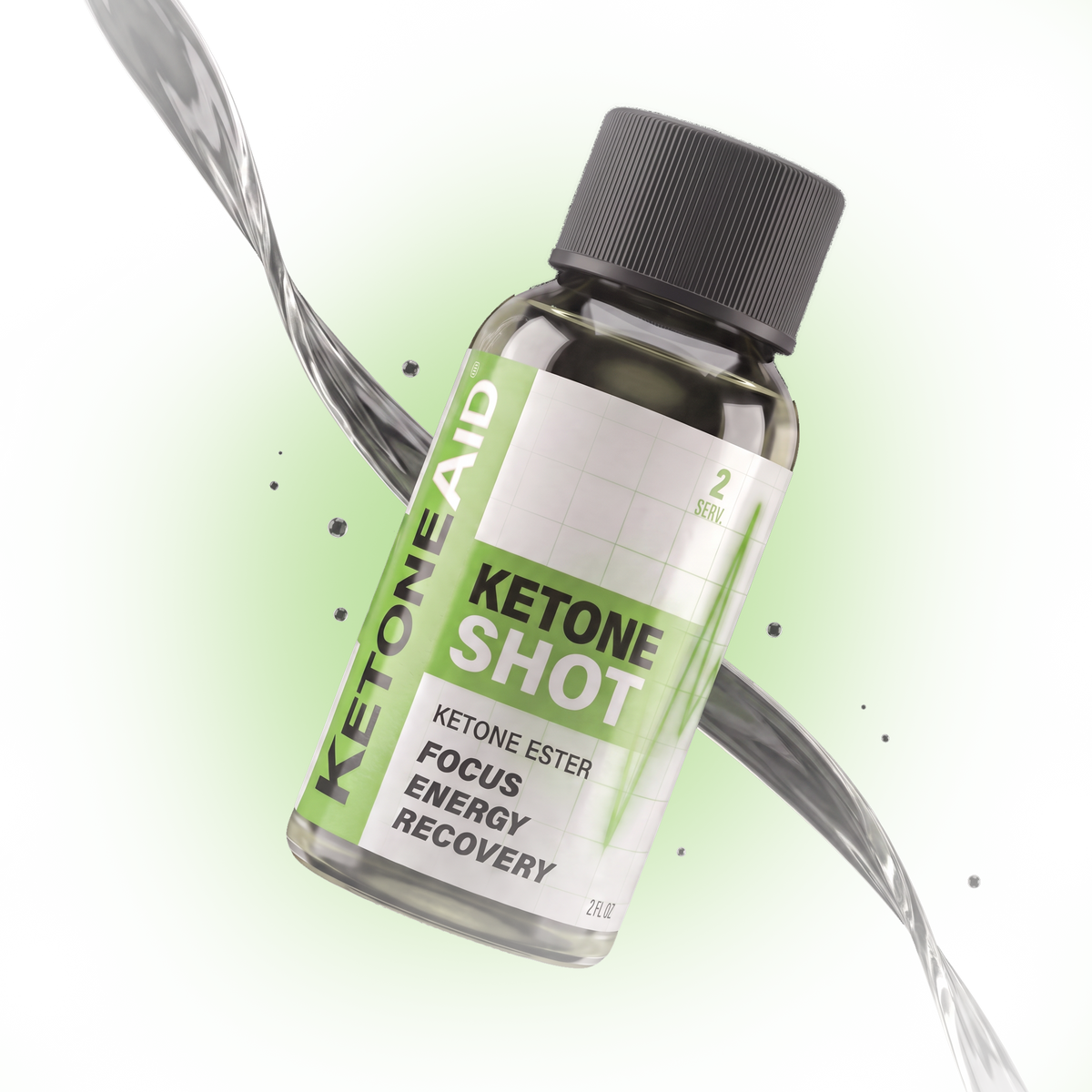
Ke4 is 50% and carries 30g per bottle — the most ester in the fewest bottles, and the most potent taste. Ke2 is 25% with 25g per bottle — the same Veech Ketone Ester, more diluted and easier to drink. The Ketone Shot is 8% with 5g per bottle, ready to drink with nothing to measure.
For a long event, the Ketone Shot is the easiest thing to carry. For a training block, most runners end up on Ke4 or Ke2 on cost per gram.
FULL REFERENCES AND STUDY DETAILS
- POFFÉ 2023 · DIRECT RUNNERPoffé C, et al. Exogenous ketosis increases circulating dopamine concentration and maintains mental alertness in ultra-endurance exercise. Journal of Applied Physiology, 2023. PMID 37141424, doi 10.1152/japplphysiol.00791.2022. 18 recreational runners attempting 60–100km. PubMed
- BRADY & EGAN 2024 · DIRECT RUNNERBrady AJ, Egan B. Acute ingestion of a ketone monoester without co-ingestion of carbohydrate improves running economy in male endurance runners. Medicine & Science in Sports & Exercise, 2024;56(1):134–142. PMID 37565450, doi 10.1249/MSS.0000000000003278. PubMed
- BRADY 2025 · DIRECT RUNNER · NULLBrady AJ, Moynagh MB, Devenney S, Egan B. Advanced footwear technology, but not acute ingestion of a ketone monoester, improves running economy in middle- and long-distance runners. Medicine & Science in Sports & Exercise, 2025;57(7):1559–1569. PMID 39999362, doi 10.1249/MSS.0000000000003682. PubMed
- EVANS 2019 · DIRECT RUNNER · NULLEvans M, McSwiney FT, Brady AJ, Egan B. No benefit of ingestion of a ketone monoester supplement on 10-km running performance. Medicine & Science in Sports & Exercise, 2019;51(12):2506–2515. PMID 31730565, doi 10.1249/MSS.0000000000002065. PubMed
- PRINS 2026 · DIRECT RUNNERPrins PJ, et al. 31-day high-dose ketone monoester supplementation in recreational runners: no improvement in 5km performance, with changes in selected cognitive and physiological measures. 2026. PMID 41773904, doi 10.1080/27697061.2026.2636551. PubMed
- ROBBERECHTS 2026 · ADJACENT · CYCLINGRobberechts R, Bekhuis Y, Stalmans M, et al. Post-exercise ketone supplementation improves endurance performance and mitochondrial adaptations during an 8-week endurance training intervention. The Journal of Physiology, 2026. PMID 41757674, doi 10.1113/JP290315. PubMed
- POFFÉ 2019 · ADJACENT · CYCLINGPoffé C, Ramaekers M, Van Thienen R, Hespel P. Ketone ester supplementation blunts overreaching symptoms during endurance training overload. The Journal of Physiology, 2019;597(12):3009–3027. PMID 31039280, doi 10.1113/JP277831. PubMed
- POFFÉ 2023 · ADJACENT · CYCLINGPoffé C, Ramaekers M, Van Thienen R, Hespel P. Exogenous ketosis elevates circulating erythropoietin and stimulates muscular angiogenesis during endurance training overload. The Journal of Physiology, 2023;601(12):2345–2358. PMID 37062892, doi 10.1113/JP284346. PubMed
- ROBBERECHTS 2023 · ADJACENT · CYCLINGRobberechts R, Albouy G, Hespel P, Poffé C. Exogenous ketosis improves sleep efficiency and counteracts the decline in REM sleep after strenuous exercise. Medicine & Science in Sports & Exercise, 2023;55(11):2064–2074. PMID 37259248. PubMed
- ANTHONY KUNKELTwo-time USA Ultra Running national champion. Athlete reference, not a research result. Podcast
- CHRIS FARLEY · REAL-WORLD CASE STUDYChief Running Enthusiast, Pacers Running. Sub-3-hour marathon streak since 1999; 3:04:03 at the 2023 New York City Marathon, then 2:57:35 on a comeback attempt after a two-week KetoneAid protocol with no ketone ester before or during the race. Individual experience, not a controlled trial. The Washington Post covered the missed attempt and the comeback; it did not attribute the result to any product. Full podcast · WaPo: missed attempt · WaPo: comeback · Pacers Running
Veech Ketone Ester is a food. Nothing on this page is intended to diagnose, treat, cure or prevent any disease, and nothing here is medical advice. Research findings described here are measured outcomes from controlled trials in specific participant groups under specific protocols, not expected results for any individual. Research dosing protocols described on this page are not consumer instructions. Our Veech Ketone Ester molecule is manufactured in the United States.