









 Basketball
 Climbing
soon
 Combat sports
 Cycling
soon
 Golf
soon
 Motocross
soon
 Pickleball
soon
 Running
soon
 Soccer
soon
 Swimming
soon
 Tennis
soon
 Triathlon
soon
Pharmacokinetics: useful for describing exposure, peak level and duration.

Ketone science · BHB fundamentals
What Is D-BHB(D Beta-Hydroxybutyrate)?
Ketones are known as the body’s “4th fuel,” alongside carbohydrate, fat and protein. D-BHB is the main ketone body circulating in human blood when ketone production rises. Your body naturally makes predominantly D-BHB from fat, especially when carbohydrate availability is low.
But a higher D-BHB blood reading is not proof of a benefit. It just gives one snapshot, and that D-BHB raised in the blood. Performance, cognition, recovery and other outcomes from an exogenous ketone have to be tested directly — using the exact molecule being claimed.
BHB ≠ benefitD-BHB vs L-BHBThe bond is keyFollow the molecule
Start here
BHB in 30 seconds.
What does BHB stand for?Beta-hydroxybutyrate — the main ketone body circulating in human blood when ketone production rises.
What form does your body make?Predominantly D-BHB, also called R-BHB.
Other ketone bodiesAcetoacetate and acetone. Acetone is mostly a non-fuel byproduct.
How is BHB measured?Usually in blood, reported in mM. Urine testing is very unreliable and shows what was discarded, not what was useable.
Does higher BHB mean better performance?No. It means more BHB was measured. The outcome must be tested separately.
Are all ketones the same?No. D-BHB Free Acid, D BHB salts, racemic BHB Salts, R 1,3 butanediol and ketone esters are different molecules, all under the umbrella of "exogenous ketones".
The most important distinction
Blood D-BHB is a measurement snapshot.
Not a conclusive benefit.
A finger-prick blood test can tell researchers whether circulating D-BHB increased. It cannot tell them whether endurance, power, cognition or recovery improved.
An outcome. It has to be measured directly in a controlled human study.
Human evidence
4 example studies, all raised D-BHB, but the outcomes varied.
Four studies, three different molecules, one shared result on the blood D-BHB meter. What happened next is the part the meter never showed.
| What molecule was actually given | D-BHB | Outcome measured |
|---|---|---|
| Veech Ketone Ester (VKE) 8-week endurance training J Physiol · 2026 ↗ | Raised | 4% higher 30-min cycling power vs control; relative VO₂peak +12% vs +6% control |
| Veech Ketone Ester mental-fatigue crossover JSCR · 2026 ↗ | Raised | Preserved cognitive flexibility and selective attention |
| R 1,3 butanediol 16.1-km endurance TT Nutrients · 2026 ↗ | Raised | No significant TT or mean-power improvement |
| Racemic BHB salts cycling TT APNM · 2017 ↗ | Raised | ~7% lower average time-trial power than placebo |
The biomarker moved.
The outcomes did not follow.
The outcomes did not follow.
See every molecule and result side by side → Exogenous Ketones
Not one chemistry
How can exogenous ketones raise D-BHB?
There is more than one route. The routes are not interchangeable.
Direct
D-BHB Free Acid
You consume D-BHB itself. It can be absorbed directly and raise circulating D-BHB.
Low direct human outcome evidence base. Free-acid formulations are also highly acidic / low-pH and are often still buffered with a heavy salt load. Note that many manufacturers incorrectly list the D-BHB Free Acid with the 1:1 weight of water it is delivered in. So 5 grams of active D-BHB Free Acid is listed as 10 grams of "D-BHB Free Acid" on the nutritional facts. Thus making it twice as expensive as expected. And it still is half as bioavailable as Ketone Ester on a real per gram basis. So what appears cheaper may actually be much more expensive and ineffective.
Mineral-associated
BHB Salts
BHB salts combine beta-hydroxybutyrate with high amounts of minerals such as sodium, potassium, calcium or magnesium. Often sold as "with electrolytes" to shift the detriment to a benefit.
Many traditional formulations are "racemic" D and L form of BHB, also written as D/L BHB.
Common mass-market form with substantially lower D-BHB delivery than VKE in pooled human research. Limited by mineral load tolerance and bioavailability.
Precursor
R 1,3 Butanediol
Not BHB and not an ester, but an alcohol. It must be metabolized in the liver before ketone bodies appear in circulation.
A ketone precursor, not a ketone body. Limited by saturable hepatic metabolism; 1,3-butanediol has also shown CNS-depressant / sedative-like effects preclinically and alcohol-like effects including dizziness and euphoria have been reported in human studies.
Panse & Gerk 2025 ↗ Frye et al. 1981 ↗
Bonded molecule
Veech Ketone Ester
D-BHB enzymatically bonded to R 1,3 butanediol. After consumption human enzymes hydrolyze the ester and release D-BHB Free Acid while the R 1,3 butanediol portion generates additional D-BHB downstream.
A bonded ketone monoester with 75+ studies and direct human outcome research. The most extensively studied ketone in humans. (No other ketone ester comes close.)
D-BHB vs L-BHB
What is the difference between D-BHB and L-BHB?
Why the D form matters.
The human body naturally produces predominantly D-BHB during ketogenesis. Many conventional BHB salts are racemic, typically containing approximately 50% D-BHB + 50% L-BHB.
While L-BHB does successfully enter the bloodstream, there’s a catch: it's not an active fuel source. Because your cells aren't burning it for energy, it clears out at a sluggish pace, "pooling" in your blood much longer than D-BHB. It’s easy to mistake this lingering presence for a "long-lasting" benefit or proof of a stronger product. However, elevated numbers on a ketone meter only help if those ketones are actually being burned. It’s not a slow release of energy—it’s just a slower metabolism, without the energy. (Note some will hypothesize that there is a "signaling" benefit. Most researchers prefer the bioavailable D form.)
A label saying “10 grams BHB” therefore does not necessarily mean “10 grams D-BHB.” Also note the 10g will count the weight of the salt, which can be 20%, so even 10 grams of D-BHB salts is only 8 grams of D-BHB ketones.
Question to ask
When a study or label says “BHB,” is it D-BHB, L-BHB, or a mixture of both? If undisclosed, the default is almost always a racemic mixture.
The chemistry changes the molecule
The ester bond is key.
The Veech Ketone Ester is not D-BHB and R 1,3 butanediol poured into the same bottle. The bond creates a different molecule — and the human evidence belongs to that molecule.
Veech Ketone Ester
D-BHBR 1,3 butanediol
One defined molecule. D-BHB and R 1,3 butanediol are enzymatically joined by an ester bond. The whole administered molecule is what was tested in most ketone papers. Hydrolysis releases D-BHB directly, while the R 1,3 butanediol portion is converted into additional D-BHB downstream.
Free-acid + diol blend
D-BHB Free Acid+R 1,3 butanediol
Two separate molecules. Mixing them in a drink does not create an ester bond, recreate the Veech Ketone Ester, or inherit the human outcomes demonstrated in trials that used it. Drug companies often make an ester form of molecules to increase bioavailability.
Same components do not mean the same final molecule.
An unbonded blend delivers two separate ingredients — D-BHB Free Acid and R 1,3 butanediol — each with its own pharmacokinetics.
It does not become VKE in the bottle, and it does not inherit VKE’s pharmacokinetics, BHB-delivery efficiency, or human outcome data.
The difference has been tested directly.
In a randomized crossover human study, equal 10g active amounts of Veech Ketone Ester, D-BHB Free Acid + R 1,3 butanediol, and R 1,3 butanediol alone all raised BHB. Calculated from the published baseline and peak values, the approximate rise above baseline was +1.7 mM for the Veech Ketone Ester, +1.2 mM for the D-BHB Free Acid + R 1,3 butanediol blend, and +0.8 mM for R 1,3 butanediol alone. VKE also produced the highest peak and greatest incremental BHB exposure.
More importantly, the performance and cognitive results discussed on this page were measured with the Veech Ketone Ester itself — not with an unbonded D-BHB + R 1,3 butanediol mixture.
The ester structure is the molecule. VKE delivers D-BHB directly and generates additional ketones downstream. A blend of the two free ingredients may contain familiar component names, but it is still a different product with a different evidence base.
Do not confuse the biomarker with the molecule
D-BHB Free Acid can raise blood ketones.
It does not deliver the Veech Ketone Ester evidence.
D-BHB Free Acid can be absorbed directly. If the goal is simply to move a blood-ketone meter (a goal we don't agree with), it can do that. But its free-acid form is also highly acidic with a distinctly sour taste. And in the direct matched-dose commercial comparison, the D-BHB Free Acid + R 1,3 butanediol blend produced a significantly smaller D-BHB response than Veech Ketone Ester (VKE).
The interest in VKE comes from human trials that measured actual outcomes — including endurance power, training adaptation and cognitive performance — plus a deep body of dose-response, pharmacokinetic, safety and tolerability data. D-BHB Free Acid is a different molecule and does not inherit those results simply because the same biomarker rises.
Why VKE?
Why researchers keep choosing the Veech Ketone Ester.
The Veech Ketone Ester (VKE) — commonly called the Ketone Monoester or KME — is the most extensively studied ketone in humans. Why VKE? Because VKE itself is the molecule that has been tested, again and again, in third-party controlled human studies — and those results belong to it, not to “ketones” in general.
It has extensive human safety and tolerability data, avoids the mineral-load and free-acid acidity constraints of other common forms, and does not rely entirely on hepatic conversion of a ketone precursor. Its dose-response and pharmacokinetics are well characterized, and it has the deepest direct human outcome evidence in the category. That combination — efficient delivery, repeatability, tolerability and a long track record as study material — is why independent research groups keep choosing VKE for studies of exogenous ketosis, performance, training adaptation, cognition and metabolism. The D-BHB blood levels are supporting evidence; the direct human outcome research is the separate, and more important, part.
+4%
30-minute cycling power vs control
8-week supervised endurance-training study · 2026
+15%
Training load + late-stage endurance power
3-week training-overload protocol · 2019
75+
Published studies
Conservative KetoneAid count for the Veech Ketone Ester research base
Performance was actually measured.
After eight weeks of training, 30-minute time-trial power was 4% higher than control; relative VO₂peak increased 12% versus 6% in control.
In the three-week overload study, sustainable training load and power during the final 30 minutes of a two-hour endurance test were both 15% higher than control.
Cognition was actually measured.
In a 2026 double-blind crossover study, VKE preserved cognitive flexibility and selective attention during experimentally induced mental fatigue.
During a 100 km trail run, placebo runners showed slower reaction and movement times while the VKE group maintained psychocognitive performance and had higher circulating dopamine.
Not every VKE study is positive. Results vary by population, dose, timing and endpoint. Each result should be attributed to the exact molecule and protocol tested. We recommend you read beyond the title as it can lead to incorrect conclusions.
No Other Ketone Comes Close.
The rule for reading ketone research
A D-BHB blood reading is not a license to borrow another molecule’s research.
If a study used the Veech Ketone Ester and measured a performance or cognitive outcome, another ingredient does not inherit that result merely because it also raises blood D-BHB.
Avoid the naming trap
Ketone naming guide.
The same molecule can have several names, while generic terms such as “ketone ester” can refer to several chemically different molecules.
The Veech Ketone Ester
| Preferred name here | Veech Ketone Ester (VKE) |
|---|---|
| Common research name | Ketone Monoester (KME) |
| Common abbreviation | VKE, KME, KE |
| Historic / common names | The Ketone Ester, Veech Ester, NIH Ester, D-beta-Hydroxybutyrate Ester |
| Chemical name | (R)-3-hydroxybutyl (R)-3-hydroxybutyrate |
| Alternate systematic name | (3'R)-3'-hydroxybutyl (3R)-3-hydroxybutanoate |
Historically, this molecule was often simply called “the ketone ester.” Today that shorthand can be misleading because several structurally different ketone esters exist. "Ketone Ester" does not always mean Veech Ketone Ester. King 2023 ↗
R 1,3 Butanediol
| Preferred clear name | R 1,3 butanediol |
|---|---|
| Alternative Names | D 1,3 butanediol; R Butylene Glycol |
| Abbreviations | RBDO, R-BDO |
| Potentially ambiguous | BDO; 1,3 butanediol |
| Industry / informal terms | Ketone Diol, Diol |
| Trade name | Ketohol® — used for R 1,3 butanediol in Hard Ketones alcohol-alternative beverages |
Search terminology
What do people mean by “BHB supplement” or “ketone supplement”?
“BHB supplement” and “ketone supplement” are shopping terms, not chemical definitions.
“D-BHB supplements” and “ketone supplements” are beginner-type search terms, not chemical definitions.
Searches for a beta hydroxybutyrate supplement return the same mixed shelf: many of those products are BHB salts (often in super low dose capsule form), while others contain D-BHB Free Acid, R 1,3 butanediol, ketone esters, MCTs or blends. The category label alone tells you almost nothing about the molecule being consumed or the evidence behind it.
What exact molecule does it contain — and what human evidence exists for that molecule?
Food-category note
The Veech Ketone Ester is used by KetoneAid as a food ingredient, not as a dietary-supplement ingredient.
FDA GRAS Notice 515 covers D-beta-hydroxybutyrate ester for intended use in bars, gels and beverages, and FDA responded that it had “no questions” regarding the notifier’s GRAS conclusion for those intended uses. This is different than "self-assessed GRAS" or "GRAS Affirmed."
Frequently asked
BHB questions, answered directly.
What is beta-hydroxybutyrate?
Beta-hydroxybutyrate, or BHB, is the primary ketone body circulating in human blood when ketone production rises. The body naturally produces predominantly D-BHB.
What does BHB stand for?
BHB stands for beta-hydroxybutyrate, the main ketone body circulating in human blood when ketone production rises. The body naturally produces predominantly D-BHB.
Does a higher BHB number mean a ketone product works better?
No. A higher reading means more BHB was measured in the blood. Performance, cognition, recovery and other outcomes must be tested separately.
What are “bioidentical ketones,” and are they the same as a ketone ester?
“Bioidentical ketones” is a marketing term commonly used for D-BHB Free Acid because D-BHB is the predominant ketone molecule naturally produced by the human body. Some products combine D-BHB Free Acid with R 1,3 butanediol and position the blend as a cheaper alternative to the Veech Ketone Ester. It is not the same molecule. A blend contains two separate ingredients, so each retains its own pharmacokinetics, limitations and evidence base. VKE chemically bonds D-BHB to R 1,3 butanediol through an ester bond, creating one defined molecule with different pharmacokinetics. In direct matched-dose human testing, VKE produced a significantly greater D-BHB response than the unbonded D-BHB Free Acid + R 1,3 butanediol blend. The results are different — and where the two formulations have been directly compared, VKE produced the superior D-BHB blood delivery result.
To make it even more confusing, some companies are now referring to the L BHB form and the racemic BHB salts as being "bioidentical" or "bioavailable." This is new and based on trace amounts of L found in humans. Science has also found trace existance of ingredients like formaldehyde but never referred to it as being bioidential.
Is D-BHB mixed with R 1,3 butanediol the same as the Veech Ketone Ester?
No. The Veech Ketone Ester is one bonded molecule. A D-BHB Free Acid + R 1,3 butanediol mixture contains two separate molecules. Some products position that blend as a cheaper alternative to VKE, but the chemistry is different. The two free ingredients retain their individual pharmacokinetics and limitations; mixing them does not recreate the ester bond or inherit the results from trials that tested VKE. In direct matched-dose human testing, VKE produced a significantly greater D-BHB response than the unbonded blend, and VKE has the much deeper direct human outcome evidence base. And simply taking more to match D-BHB blood levels does not inherit the performance results of Ketone Ester.
Is R 1,3 butanediol a ketone?
Most agree it is not. It is better described as a ketone precursor. It must be metabolized before ketone bodies appear in circulation.
Are all "Ketone Esters" the same?
No. “Ketone Ester” means 2 or more ingredients were chemically or enzymatically bonded together, where at least one ingredient is BHB or converts to BHB. Different esters have different structures and can produce different metabolites and outcomes. The exact ester used in a study matters. There are also "Ketone Di-Ester."
Does every Veech Ketone Ester study show a benefit?
No. Results vary by study design, population, dose and endpoint. Each result should be attributed to the exact molecule and protocol tested rather than inferred from a BHB reading. It is important to read the full paper as a title can miss the essense of a study.
Do exogenous ketones put you in ketosis?
They can raise circulating ketones without fasting or carbohydrate restriction, creating a temporary state of "exogenous ketosis". That is not the same thing as nutritional or endogenous ketosis produced by fasting or a ketogenic diet, and the broader metabolic context can be different.

The key takeaway
The ketone molecule type matters.
The evidence belongs to the molecule that was tested.
The evidence belongs to the molecule that was tested.
D-BHB Free Acid, BHB salts, R 1,3 butanediol and different ketone esters are chemically distinct compounds. A shared ability to raise blood BHB does not make their human outcomes interchangeable.
Don’t stop at “Does it raise ketones?”
Ask: “Which molecule was tested — and what did the study actually show?”
Ask: “Which molecule was tested — and what did the study actually show?”
Try the molecule
Ready to try the ketone used in the research?
Every product below contains Veech Ketone Ester — the same molecule used in the studies cited on this page. Not a precursor, not a salt, not a different ester.
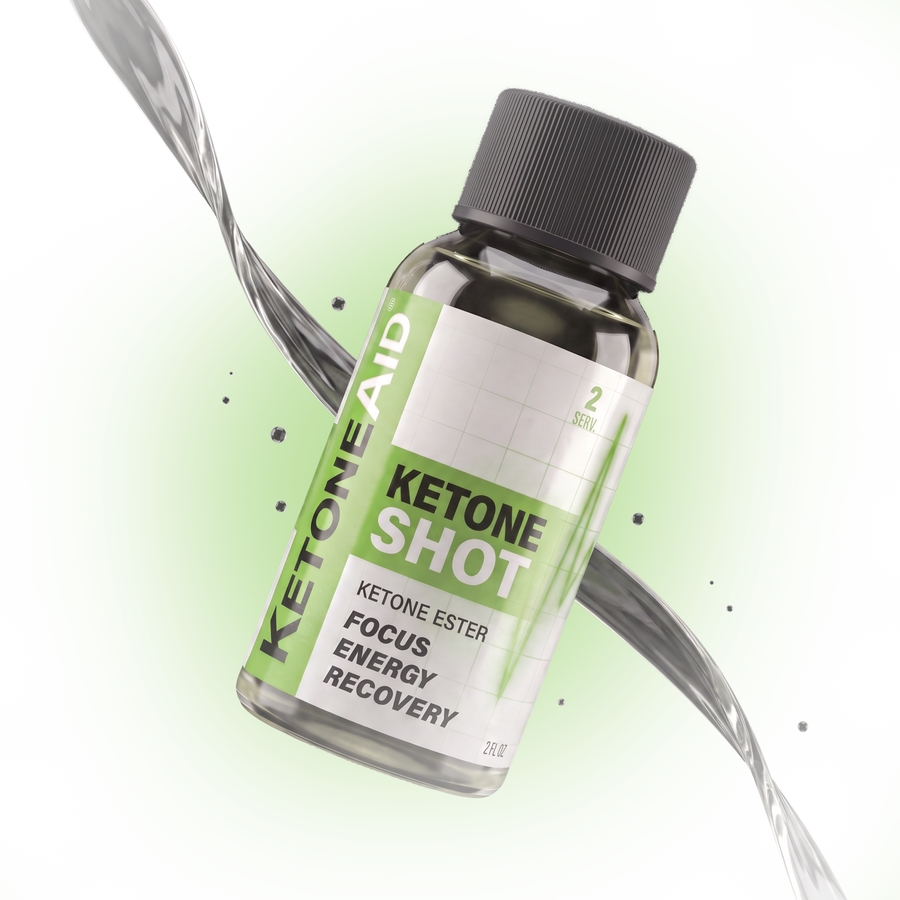 Ketone Shot→8% VKE
“Almost Yummy”
2 “servings”
 Ke2→25% VKE
“Not Bad” tasting
10 “servings”
 Ke4→50% VKE
Potent taste
12 “servings”
Best seller
Dosing & timing: Ketone Shot · Ke2 · Ke4
Lifetime No-Risk Guarantee · Pay with HSA/FSA
Primary sources
Core references.
Robberechts R, Bekhuis Y, Stalmans M, et al.
Post-exercise ketone supplementation improves endurance performance and mitochondrial adaptations during an 8-week endurance training intervention. The Journal of Physiology. 2026.
View study ↗
Post-exercise ketone supplementation improves endurance performance and mitochondrial adaptations during an 8-week endurance training intervention. The Journal of Physiology. 2026.
View study ↗
Poffé C, Ramaekers M, Van Thienen R, Hespel P.
Ketone ester supplementation blunts overreaching symptoms during endurance training overload. The Journal of Physiology. 2019.
View study ↗
Ketone ester supplementation blunts overreaching symptoms during endurance training overload. The Journal of Physiology. 2019.
View study ↗
Stubbs BJ, Cox PJ, Evans RD, et al.
On the Metabolism of Exogenous Ketones in Humans. Frontiers in Physiology. 2017.
View study ↗
On the Metabolism of Exogenous Ketones in Humans. Frontiers in Physiology. 2017.
View study ↗
Falkenhain K, Daraei A, Little JP.
The Effect of Novel Exogenous Ketone Supplements on Blood Beta-Hydroxybutyrate and Glucose. Journal of Dietary Supplements.
View study ↗
The Effect of Novel Exogenous Ketone Supplements on Blood Beta-Hydroxybutyrate and Glucose. Journal of Dietary Supplements.
View study ↗
Carpenter M, Brouner J, Spendiff O.
Acute 1,3-Butanediol Co-Ingestion with Carbohydrate Does Not Improve Endurance Performance in Chronically Ketogenic Male Athletes. Nutrients. 2026.
View study ↗
Acute 1,3-Butanediol Co-Ingestion with Carbohydrate Does Not Improve Endurance Performance in Chronically Ketogenic Male Athletes. Nutrients. 2026.
View study ↗
O'Malley T, Myette-Côté E, Durrer C, Little JP.
Nutritional ketone salts increase fat oxidation but impair high-intensity exercise performance in healthy adult males. APNM. 2017.
View study ↗
Nutritional ketone salts increase fat oxidation but impair high-intensity exercise performance in healthy adult males. APNM. 2017.
View study ↗
Waldman HS, Shepherd BD, Egan B, McAllister MJ.
Exogenous Ketone Salts Do Not Improve Cognitive Performance During a Dual-Stress Challenge. IJSNEM. 2020.
View study ↗
Exogenous Ketone Salts Do Not Improve Cognitive Performance During a Dual-Stress Challenge. IJSNEM. 2020.
View study ↗
Poffé C, Robberechts R, Van Thienen R, Hespel P.
Exogenous ketosis increases circulating dopamine concentration and maintains mental alertness in ultra-endurance exercise. J Appl Physiol. 2023.
View study ↗
Exogenous ketosis increases circulating dopamine concentration and maintains mental alertness in ultra-endurance exercise. J Appl Physiol. 2023.
View study ↗
Roca GM, Barker GA, Waldman HS.
Ketone Monoester, With and Without Caffeine, Prevents Mental Fatigue and Preserves Cognitive Performance. JSCR. 2026.
View study ↗
Ketone Monoester, With and Without Caffeine, Prevents Mental Fatigue and Preserves Cognitive Performance. JSCR. 2026.
View study ↗
King MT.
Ketone ester — what's in a name? Ambiguity begets uncertainty. Frontiers in Physiology. 2023.
View paper ↗
Ketone ester — what's in a name? Ambiguity begets uncertainty. Frontiers in Physiology. 2023.
View paper ↗
Panse N, Gerk PM.
Characterizing the Hepatic Metabolic Pathway of Ketone Ester and Subsequent Metabolites Using Human and Rat Liver Fractions. The AAPS Journal. 2025. R 1,3 butanediol showed saturable hepatic metabolism in human liver fractions, while Veech Ketone Ester showed rapid, non-saturable clearance over the concentrations tested.
View paper ↗
Frye GD, Chapin RE, Vogel RA, et al.
Effects of acute and chronic 1,3-butanediol treatment on central nervous system function: a comparison with ethanol. J Pharmacol Exp Ther. 1981.
View paper ↗
Effects of acute and chronic 1,3-butanediol treatment on central nervous system function: a comparison with ethanol. J Pharmacol Exp Ther. 1981.
View paper ↗
U.S. Food and Drug Administration.
GRAS Notice No. 515 — D-beta-hydroxybutyrate ester; intended uses include bars, gels and beverages.
View FDA notice ↗
GRAS Notice No. 515 — D-beta-hydroxybutyrate ester; intended uses include bars, gels and beverages.
View FDA notice ↗