

Veech Ketone Ester
(R)-3-hydroxybutyl (R)-3-hydroxybutyrateOne bonded "ester" molecule. Hydrolysis releases D-BHB directly; the R 1,3 butanediol portion is then metabolized and generates additional D-BHB ketones.
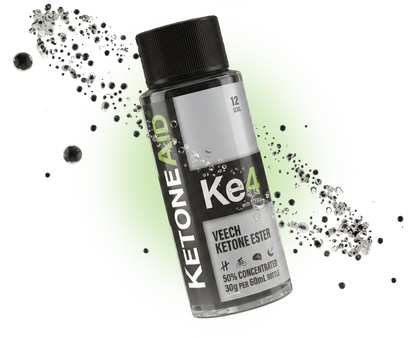
Bonded ester%VKE concentration decides taste. Same Veech Ketone Ester in all three, just at different dilutions.

Strong, bitter and most compact.
Not “better”, just less water.

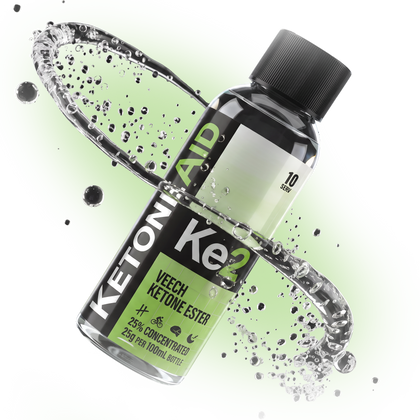
3x the water of Ke4, same price per g as Ke4. Balanced value & taste.
25g VKE per btl. · 'Not Bad'
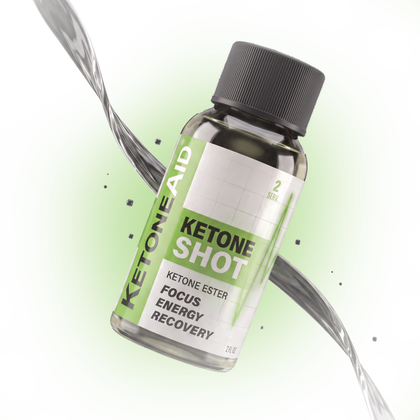
Ready to drink, nothing to measure.
1st time? Taste an issue? Start Here.


Real Buzz. No Booze.™(not for focus+performance)
 Focus & cognitionDemanding workdays, exams, long meetings
 Stamina & enduranceLong efforts without the crash
 Healthy aging & muscleStaying strong past 50
 Sleep after trainingA small amount before bed
 "Ketosis" & fastingKetones without the diet
 RecoveryAfter hard sessions and back-to-back days
 Basketball
 Climbing
 Combat sports
 Cycling
 Golf
 Motocross
 Pickleball
 Running
 Skiing
 Soccer
soon
 Swimming
 Tennis
 Triathlon
%VKE concentration decides taste. Same Veech Ketone Ester in all three, just at different dilutions.
Very Scary 🍒 • 30g VKE / btl.
Not 'better'. Just less water.
'Not Bad' 🍏 flavor • 25g / btl.
Same price per g VKE as Ke4,
just 3x more water.
'Almost Yummy' 🍑 • 5g / btl.
More $/g for convenience+flavor.
1st time? Taste an issue? Start here
Real Buzz. No Booze.™(not for focus+performance)
Cart
Your cart is empty
Ketone product pages often cite research. The important question is whether the study tested the same molecule that is actually in the bottle. Here is the test — and how to run it on any product page in about a minute.
Product-specific evidence starts with identity: check if the study tests the same molecule actually in the product. Whether it directly supports a particular claim then depends on dose, timing, population and the outcome measured.
Two different questions. A study on a different ketone molecule is evidence for that molecule, however similar the blood D-BHB reading looks — it is not product-specific at all. A study on the right molecule at a different dose, in a different population, or measuring a different outcome is still evidence about the molecule; it just is not direct support for that specific claim. And a study that only shows blood ketones went up is a biomarker result, whatever molecule it used.
Links 1–3 are the identity match: is this evidence actually about the product? Links 4–5 are claim applicability: does it directly support this dose, use, population and outcome? Run a claim through all five before you give it credit.
Every ketone product below can raise a blood D-BHB ketone reading. They are four different chemicals, with four different human research records. A claim that says “ketones have been shown to…” has skipped link 2.
One bonded "ester" molecule. Hydrolysis releases D-BHB directly; the R 1,3 butanediol portion is then metabolized and generates additional D-BHB ketones.
Bonded esterThe ketone body itself, taken as a free acid. Raises circulating D-BHB without a precursor step. Sounds perfect — but it is a strong acid in the bottle, and in the one human comparison on this site the ester reached a higher D-BHB peak.
Free ketone acidSalts combined with BHB. Racemic BHB salts contain both D- and L-BHB; in the controlled human comparison cited here, the salt drink contained 50% L-BHB.
Salt-LoadedAn alcohol the liver converts to ketones. On its own it is a different starting molecule from the ester that contains it.
PrecursorTo make it even MORE confusing, “Ketone ester” is not one molecule either. Several "ketone ester" molecules exist with different structures and different kinetics; one of the Veech Ketone Ester’s own developers has argued the term is too ambiguous to stand on its own.¹ Hence why researchers began to use the phrase "Veech Ketone Ester" so people know exactly which molecule it is. The full breakdown of each type, with its human results, lives on Compare Exogenous Ketones.
Five situations you will meet on ketone product pages, and what the human research says about each. Every example is a published study; the reference list is at the bottom of the page.
| Situation | Transfers? | What the research shows |
|---|---|---|
| Same molecule, same protocolThe study describes the product as used. | ✓Yes | Poffé and colleagues gave physically active young men 25 g of Veech Ketone Ester after exercise and before sleep through three weeks of overload cycling. Sustainable training load and final 30-minute power in the 2-hour endurance test were about 15% higher than control. That result attaches to that molecule, that schedule and that population.Poffé et al. · J Physiol 2019 |
| Same molecule, different protocolDose, timing or context changed. | Molecule yes · claim no | Two studies gave the same ester during post-exercise recovery and measured muscle glycogen. Under a controlled high-glucose clamp, glycogen was higher with the ester. With a standard carbohydrate-and-protein recovery drink, it was not. Same molecule, different protocol, different answer — still evidence about the molecule, but neither result is direct support for the other protocol.Holdsworth et al. · Med Sci Sports Exerc 2017 · Vandoorne et al. · Front Physiol 2017 |
| Same molecule, different outcomeThe study measured something else. | Molecule yes · claim no | In a 31-day trial, recreational runners took 30 g of Veech Ketone Ester three times daily. Post-dose blood BHB reached about 3 mM. Executive-function measures improved; 5-km time-trial performance did not differ from placebo. One study, one molecule, two outcomes — product-specific for both, direct support only for the one that improved.Prins et al. · J Am Nutr Assoc 2026 |
| Different molecule, also raises BHB“It gets you into ketosis too.” | ✕No | At a matched 10 g dose in the same twelve fasted adults, the Veech Ketone Ester, a D-BHB free acid plus R 1,3 butanediol blend, and R 1,3 butanediol alone produced three different BHB curves — the ester roughly double the precursor alone.* And in a separate trial, racemic BHB salts raised BHB while average time-trial power was about 7% lower than placebo. The reading is not the result.Falkenhain et al. · J Diet Suppl 2024 · O’Malley et al. · Appl Physiol Nutr Metab 2017 |
| Same words, different chemistry“Ketone ester” on both labels. | ✕No | “Ketone ester” does not identify one molecule. In professional cyclists, a 1,3-butanediol acetoacetate diester (also called a "ketone ester") raised circulating D-BHB ketones, barely, but impaired a ~31-km time trial by about 2%, with substantial GI discomfort. That result belongs to that diester; it does not describe the Veech Ketone Ester. Check the chemical name, not the category word.Leckey et al. · Front Physiol 2017 · King · Front Physiol 2023 |
* Approximate rise above baseline calculated from the published baseline and peak values (about +1.7, +1.2 and +0.8 mM), not treatment-effect figures quoted verbatim from the paper. A twelve-person pharmacokinetic pilot in healthy, fasted adults; it measured BHB exposure, not performance or cognition.
The molecule that was tested
At the dose, timing and population in the Methods — measuring the outcome in the Results.
Anything else that shares a metabolite
A different molecule that also raises blood D-BHB has a different research record — and has to earn its claims with its own studies.
Our study index identifies the exact molecule, study material and reported result, with dose and protocol details where verified.
Open the study indexBlood D-BHB is exposure. Focus, performance and recovery are outcomes. A study can raise one without moving the other — so “clinically shown to raise ketones” is a pharmacokinetic statement, not a benefit.
Raises blood ketones ≠ shows an outcome
What a blood D-BHB reading can and cannot tell you is covered on What Is BHB?. This page only asks one thing of it: when a citation is offered as proof, look at which column it came from.
Prins et al., J Am Nutr Assoc 2026 — 18 recreational runners, 31 days, Veech Ketone Ester 30 g three times daily. Indexed in Clinical Studies.
Four checks, in the order they usually fail.
Watch out for reviews and meta-analyses. They can be useful, but they often lump every ketone molecule into one bucket and conclude that "ketones sometimes work." Pull the pooled studies apart and a pattern shows up: most of the Veech Ketone Ester papers reported a result; the non-VKE papers mostly did not. Check which molecules were included and whether molecule-specific results were reported.
If questions 1–3 fail, it is not product-specific evidence. If questions 4–5 fail, it is not direct support for that use or outcome — whatever the page says.
KetoneAid products use the Veech Ketone Ester — (R)-3-hydroxybutyl (R)-3-hydroxybutyrate — not free R 1,3 Butanediol, BHB salts, or an unbonded D-BHB + diol blend.
That does not turn every VKE study into a promise for every use. It does mean the evidence starts with the right molecule: the one actually in the bottle.
Every indexed Veech Ketone Ester human study, with molecule, study material and reported result — plus dose and protocol details where verified.
Browse the studies The moleculesKetone ester, R 1,3 butanediol, BHB salts and D-BHB free acid — what each one is and what it has shown.
Compare the types The researchThe molecule, where it came from, and the human evidence behind it.
Explore VKE science The productsCommercial ketone products compared by the molecule they contain and the evidence attached to it.
See the comparison