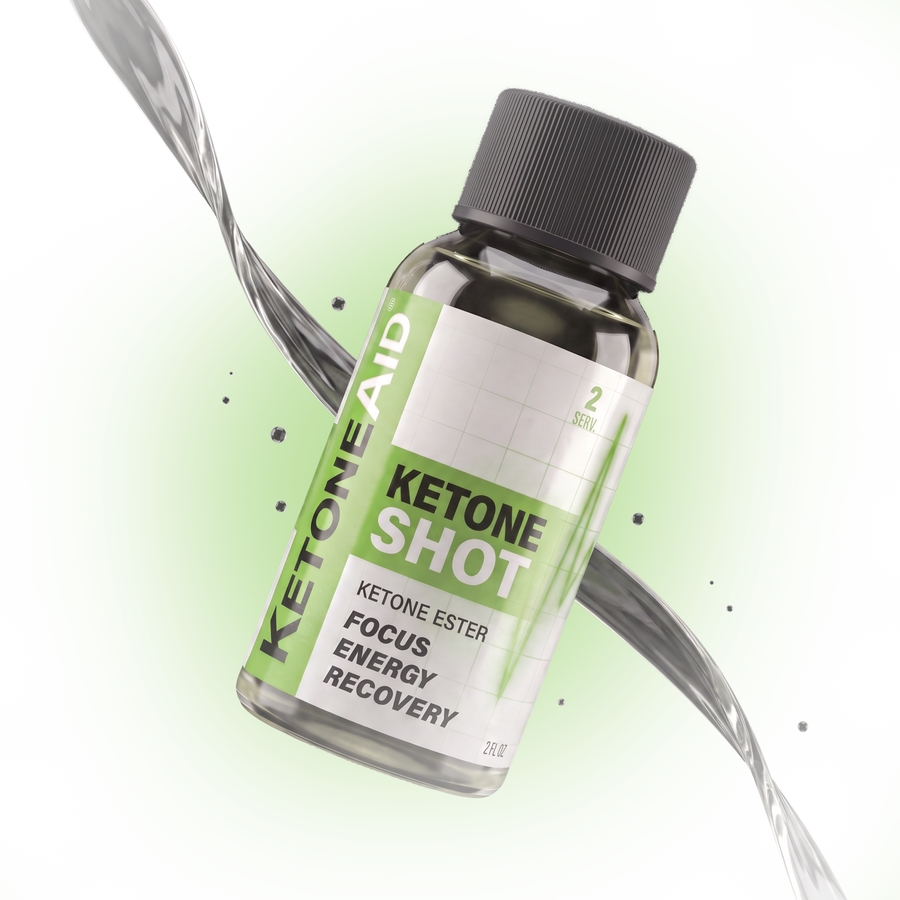
Veech Ketone Ester (VKE)
Releases D-BHB directly; the R 1,3 butanediol portion generates additional ketone bodies downstream.
75+ studies and the strongest direct human research base in the category.
%VKE concentration decides taste. Same Veech Ketone Ester in all three, just at different dilutions.
Strong, bitter and most compact.
Not “better”, just less water.
3x the water of Ke4, same price per g as Ke4. Balanced value & taste.
25g VKE per btl. · 'Not Bad'
Ready to drink, nothing to measure.
1st time? Taste an issue? Start Here.
Real Buzz. No Booze.™(not for focus+performance)
Focus & cognitionDemanding workdays, exams, long meetings
Stamina & enduranceLong efforts without the crash
Healthy aging & muscleStaying strong past 50
Sleep after trainingA small amount before bed
"Ketosis" & fastingKetones without the diet
RecoveryAfter hard sessions and back-to-back days
Basketball
Climbing
soon
Combat sports
Cycling
soon
Golf
soon
Motocross
soon
Pickleball
soon
Running
soon
Soccer
soon
Swimming
soon
Tennis
soon
Triathlon
soon
Backpacking
soon
Gaming
soon
%VKE concentration decides taste. Same Veech Ketone Ester in all three, just at different dilutions.
Very Scary 🍒 • 30g VKE / btl.
Not 'better'. Just less water.
'Not Bad' 🍏 flavor • 25g / btl.
Same price per g VKE as Ke4,
just 3x more water.
'Almost Yummy' 🍑 • 5g / btl.
More $/g for convenience+flavor.
1st time? Taste an issue? Start here
Real Buzz. No Booze.™(not for focus+performance)
Basketball
Climbing
soon
Combat sports
Cycling
soon
Golf
soon
Motocross
soon
Pickleball
soon
Running
soon
Soccer
soon
Swimming
soon
Tennis
soon
Triathlon
soon
Backpacking
soon
Gaming
soon
Panier
Votre panier est vide
Ketone science · Category guide
Ketones are sometimes called the body’s “4th fuel,” alongside carbohydrate, fat and protein. Your liver naturally makes ketone bodies from fat, especially when carbohydrate availability is low; the primary circulating ketone is D-BHB. Exogenous means “from outside the body.” Exogenous ketones are ketones or compounds used to produce D-BHB that you consume rather than make naturally through fasting or carbohydrate restriction.
“Exogenous ketones” is a category. It is not one molecule. BHB salts, D-BHB Free Acid, R 1,3 butanediol, ketogenic fats and different ketone esters use different chemistry — and they have not produced the same human results.
Start here
One category · Multiple chemistries
"Ketone drink” does nto describe the ingredient. It may contain Veech Ketone Ester (VKE), BHB salts, free D-BHB or R-1,3-butanediol. Compare the molecule and the research behind it before comparing flavors, bottle sizes or brands. They all get grouped under the word “ketones.” Chemically, they are very different.
Releases D-BHB directly; the R 1,3 butanediol portion generates additional ketone bodies downstream.
75+ studies and the strongest direct human research base in the category.
Unbonded D-BHB. It is absorbed directly and raises circulating D-BHB.
Low direct human outcome evidence base. Free-acid formulations are also highly acidic / low-pH.
A ketogenic alcohol and ketone precursor — not D-BHB. It must be metabolized before ketone bodies appear.
Raises D-BHB; controlled athlete studies shown below reported no significant performance benefit.
BHB associated with minerals. Many conventional products are racemic D/L-BHB.
Common mass-market form; substantially lower D-BHB delivery than VKE in controlled and pooled human research. Limited by mineral load tolerance.
MCTs are fats, not ketone bodies. Like R 1,3 butanediol, they can function as ketogenic precursors.
Commonly included in the broader exogenous-ketone category, but chemically closer to a ketogenic fat than an exogenous ketone body and generally produces a smaller ketone rise.
Structurally different ketone esters now exist. “Ketone ester” does not identify one molecule.
Different esters do not inherit VKE results.
Why include MCTs? MCTs are not ketone bodies, but neither is R 1,3 butanediol. Both are better described chemically as ketogenic precursors because metabolism of the ingredient raises ketone production. That is another reason the category name alone is not enough.
Straight answer
This is not a comparison of unrelated studies. A randomized crossover trial tested three commercial ketone formulations in the same participants at the same 10g active dose.
Matched-dose head-to-head
Comparing peaks across unrelated studies is messy. This study tested three commercial products in the same 12 healthy, fasted adults, on separate days, at a matched 10g dose of active ingredient.
Falkenhain, Daraei and Little conducted a double-blind, randomized crossover pilot at the University of British Columbia.
Each participant consumed a version of Ke4, Kenetik and Ketone-IQ under the same study protocol.
| Product tested | Active ketone chemistry | Blood D-BHB response |
|---|---|---|
| KetoneAid Ke4 · Veech Ketone Ester | Ketone monoester: D-BHB bonded to R 1,3 butanediol | ≈ +1.7 mM above baseline* |
| Kenetik | D-BHB Free Acid + R 1,3 butanediol | ≈ +1.2 mM above baseline* |
| Ketone-IQ | R 1,3 butanediol | ≈ +0.8 mM above baseline* |
*Adjusted-rise note: calculated from the published baseline and peak values, the approximate rise above baseline was +1.7 mM for VKE, +1.2 mM for Kenetik, and +0.8 mM for Ketone-IQ. These are baseline-adjusted calculations from the published data, not treatment-effect values reported verbatim by the paper. This was a 12-person pharmacokinetic pilot in healthy, fasted adults. It measured D-BHB exposure, not performance or cognition.


D-BHB delivery is only step one
A ketone meter reading is an easily measured snapshot of exposure — not the whole pharmacokinetic story, and not an outcome measure for endurance, power, cognition, training adaptation or recovery.
But actual benefits have to be measured directly.
Human outcome evidence
| Exact molecule / protocol tested | D-BHB | Human outcome |
|---|---|---|
| Veech Ketone Ester8-week endurance trainingJ Physiol · 2026 ↗ | Raised | 4% higher 30-minute cycling power vs control; relative VO₂peak +12% vs +6% control |
| Veech Ketone Ester3-week training overloadJ Physiol · 2019 ↗ | Raised | 15% higher sustainable training load and 15% higher late-stage endurance power |
| Veech Ketone Estermental-fatigue crossoverJSCR · 2026 ↗ | Raised | Preserved cognitive flexibility and selective attention |
| R 1,3 butanediol16.1-km cycling TTNutrients · 2026 ↗ | Raised | No significant improvement in time-trial performance or mean power |
| R 1,3 butanediolNCAA Division I runnersNutraceuticals · 2024 ↗ | Raised | No significant improvement in time to fatigue |
| R,S-1,3-butanedioltrained cyclistsIJSNEM · 2019 ↗ | Raised | No TT or average-power benefit; GI symptoms in 5/9 |
| Racemic BHB saltscycling TTAPNM · 2017 ↗ | Raised | ~7% lower average time-trial power than placebo |
| Racemic BHB saltsphysical + mental stressIJSNEM · 2020 ↗ | Raised | No improvement in mental arithmetic or Stroop performance |
Why structure matters
Veech Ketone Ester
One bonded molecule. After hydrolysis it supplies D-BHB directly while its R 1,3 butanediol portion goes on to generate additional ketones downstream.
Unbonded blend
Two separate ingredients. Mixing them does not create the ester bond or mimic VKE’s potency, efficacy and results.
Same components do not mean the same molecule. In VKE, D-BHB is chemically bonded to R 1,3 butanediol. The whole esterified molecule is administered; metabolism of that molecule delivers D-BHB directly and generates additional ketones downstream.
The difference has been tested directly. At the same 10g active dose, bonded VKE and the unbonded D-BHB Free Acid + R 1,3 butanediol blend produced different peak and incremental D-BHB responses.
Molecule-by-molecule
Benchmark molecule
D-BHB — ester bond — R 1,3 butanediol.
Produces the strongest D-BHB response in the matched commercial comparison and has repeatedly demonstrated positive performance and cognition outcomes in controlled human studies.
It has the deepest established human pharmacokinetic and outcome evidence base in the category.
Raises circulating D-BHB directly. It is not VKE and does not inherit performance or cognition results from studies that administered VKE.
Raises D-BHB after liver metabolism. Controlled endurance studies shown here reported no significant performance improvement for the endpoints tested.
Generally produce much lower D-BHB than VKE. Human performance studies shown here are neutral or negative, including one with ~7% lower cycling power than placebo.
Naming trap
Historically, Veech Ketone Ester was often referred to simply as “the ketone ester” because it was the prominent — and by far the most extensively studied — ketone ester used in human research.
Today that shorthand is no longer precise. Other structurally different ketone esters now exist. Different esters can deliver different ketones or ketogenic precursors, generate different metabolites and produce different physiological responses.
If a claim says “ketone ester,” ask which one. A study using VKE does not validate a different ketone ester. King 2023 ↗
So which one wins?
Define “best” however you want. The evidence keeps pointing to the same molecule.
Largest D-BHB rise in the matched 10g commercial head-to-head comparison.
Deepest established human pharmacokinetic and outcome evidence base in the category.
Multiple controlled human protocols have reported significant positive outcomes.
No Other Ketone Comes Close.
Read the claim correctly
In the direct matched-dose study, approximately yes. Both products supplied 10g of active ingredient. Adjusted rise above baseline was about +1.7 mM for VKE versus +0.8 mM for Ketone-IQ.
That ~2× comparison refers specifically to D-BHB delivery. It is not a 2× performance claim. Performance, cognition and recovery have to be measured directly — and VKE has its own positive controlled-human outcome evidence rather than borrowing another molecule’s results.
How to read “science-backed”
To compare exogenous ketones correctly, separate the chemistry from the outcome. Four questions keep the category straight.
VKE, R 1,3 butanediol, D-BHB Free Acid, BHB salts and other esters are different chemistries.
How much D-BHB does the molecule deliver at a comparable dose?
Performance, cognition and recovery must be measured directly. A higher ketone reading does not prove any of them.
A VKE study is evidence for VKE — not every product that raises blood ketones.
Comparing actual brands? See KetoneAid vs Ketone-IQ, Kenetik, BHB salts and other commercial ketones →
Shopping terminology
“Ketone supplement,” “exogenous ketone supplement” and “BHB supplement” are shopping terms — not chemical definitions.
Products marketed as exogenous ketone supplements may contain BHB salts, D-BHB Free Acid, R 1,3 butanediol, ketone esters, MCTs or mixtures. The shopping category does not tell you which molecule you are buying.
Check the ingredient. Then check the evidence for that ingredient. KetoneAid products containing the Veech Ketone Ester are sold as foods, not as dietary supplements.
Frequently asked
Exogenous means originating outside the body. An exogenous ketone is consumed from outside the body rather than produced endogenously (internally) by your liver.
Exogenous ketones is a generic term for ketone bodies or ketone-producing compounds consumed to increase circulating ketones. The term describes a broad category, not one specific molecule, and different molecules have different results.
If you mean D-BHB measured in blood, Veech Ketone Ester produced the largest rise in the matched 10 g commercial head-to-head: about +1.7 mM above baseline versus +1.2 mM for Kenetik and +0.8 mM for Ketone-IQ. That is a D-BHB-delivery result, not a performance or cognition result.
In the direct matched-dose study, approximately yes. Both products supplied 10g of active ingredient. Adjusted rise above baseline was about +1.7 mM for VKE versus +0.8 mM for Ketone-IQ. That comparison is about D-BHB delivery. Performance results come from other sources.
BHB salts associate BHB with minerals such as sodium, potassium, calcium or magnesium. Ketone esters are chemically bonded molecules. In Veech Ketone Ester specifically, D-BHB is chemically bound to R 1,3 butanediol; metabolism releases D-BHB directly and generates additional ketones downstream. The chemistry, mineral load, pharmacokinetics and human evidence are very different.
Different Ketones, Different Results. A rise in blood BHB does not by itself prove a performance or cognition benefit. Look at the molecule, dose, protocol and outcome measured. Veech Ketone Ester (VKE), BHB salts and R-1,3-butanediol are not interchangeable, and their studies should not be treated as if they tested the same product. Controlled human studies using the Veech Ketone Ester have reported significant improvements in several performance and cognitive protocols. Studies using R 1,3 butanediol and BHB salts have frequently reported neutral or negative performance results for the endpoints tested.
No. BHB salts associate BHB with minerals. Ketone esters are chemically bonded molecules designed to deliver ketones or ketogenic precursors. In the Veech Ketone Ester specifically, D-BHB is chemically bonded to R 1,3 butanediol; metabolism of the esterified molecule delivers D-BHB directly and generates additional ketones downstream.
No. R 1,3 butanediol is a ketone precursor, not a ketone body and not a ketone ester. It must be metabolized before D-BHB and acetoacetate appear in circulation. Veech Ketone Ester is one bonded ketone monoester that releases D-BHB directly while its R 1,3 butanediol portion generates additional ketones downstream. The two molecules do not share the same evidence base. Why that distinction matters → What Is BHB?
MCTs are not ketone bodies. They are ketogenic fats and are better understood as ketogenic precursors. They are commonly included in the broader exogenous-ketone category, but chemically they are closer to a ketogenic fat than an exogenous ketone body and generally produce a smaller ketone rise.
Veech Ketone Ester. It has the deepest established human D-BHB-delivery and outcome evidence base among exogenous ketone forms, with the strongest combination of efficient D-BHB delivery and repeated positive controlled-human outcomes.
The word “BHB” does not identify one product or one daily amount. Veech Ketone Ester (VKE), BHB salts and free D-BHB are different forms, so their gram amounts and instructions are not interchangeable. For Ke4, Ke2 or Ketone Shot, follow the product-specific VKE protocol for your goal. A blood-BHB reading is not itself a dosing instruction.
What is the optimal BHB level?

The key takeaway
They do not raise D-BHB equally. They do not have equal research behind them. And they have not produced equal results when actual human outcomes were measured.
Try the molecule
Every product below contains Veech Ketone Ester — the same molecule used in the studies cited on this page. Not a precursor, not a salt, not a different ester.
Ke2→25% VKE
Ketone Shot→8% VKE
Dosing & timing: Ke4 · Ke2 · Ketone Shot
Lifetime No-Risk Guarantee · Pay with HSA/FSA
Primary sources