

Veech Ketone Ester
(R)-3-hydroxybutyl (R)-3-hydroxybutyrateOne defined ester molecule linking D-BHB and R 1,3 butanediol. It is the intact ester that is manufactured, dosed and tested in human trials — not a mixture of the two hydrolysis products.
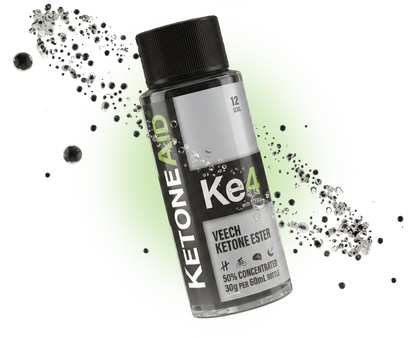
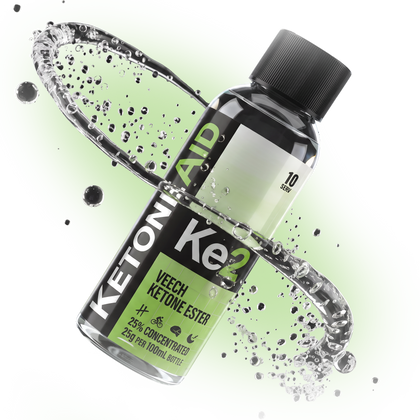
%VKE concentration decides taste. Same Veech Ketone Ester in all three, just at different dilutions.

Strong, bitter and most compact.
Not “better”, just less water.

3x the water of Ke4, same price per g as Ke4. Balanced value & taste.
25g VKE per btl. · 'Not Bad'
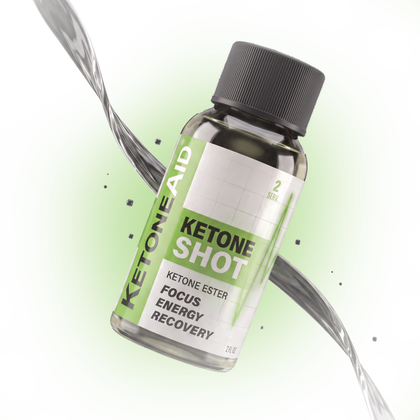
Ready to drink, nothing to measure.
1st time? Taste an issue? Start Here.


Real Buzz. No Booze.™(not for focus+performance)
 Focus & cognitionDemanding workdays, exams, long meetings
 Stamina & enduranceLong efforts without the crash
 Healthy aging & muscleStaying strong past 50
 Sleep after trainingA small amount before bed
 "Ketosis" & fastingKetones without the diet
 RecoveryAfter hard sessions and back-to-back days
 Basketball
 Climbing
 Combat sports
 Cycling
 Golf
 Motocross
 Pickleball
 Running
 Skiing
 Soccer
soon
 Swimming
 Tennis
 Triathlon
%VKE concentration decides taste. Same Veech Ketone Ester in all three, just at different dilutions.
Very Scary 🍒 • 30g VKE / btl.
Not 'better'. Just less water.
'Not Bad' 🍏 flavor • 25g / btl.
Same price per g VKE as Ke4,
just 3x more water.
'Almost Yummy' 🍑 • 5g / btl.
More $/g for convenience+flavor.
1st time? Taste an issue? Start here
Real Buzz. No Booze.™(not for focus+performance)
Cart
Your cart is empty
Both end up as blood D-BHB. How it got there is what matter most. One arrives as a bonded molecule that already contains a ketone body; the other arrives as a precursor the liver has to convert first. What that difference does — and does not — mean, with the human kinetics laid out side by side.
When Dr. Veech built the ketone ester, D-BHB was the point. The diol half is there to deliver it and then become more of it — not to be the product. Take the diol by itself and you get only the slow half, and every gram has to go through your liver first. Follow the math. In the one head-to-head trial — same people, same 10 g dose — VKE raised blood D-BHB by about 1.7 mM. Free diol raised it by about 0.8. To match VKE’s peak with free diol you’d need roughly 20 g of it. VKE gets there with about 5 g of diol inside it. Yes, 4x — four times the less useful half of the molecule, for the same peak.
The Veech Ketone Ester is one bonded molecule. Hydrolysis releases one D-BHB molecule directly and one R 1,3 butanediol molecule; the released R 1,3 butanediol is then converted in the liver into additional ketones. Free R 1,3 butanediol is a different starting molecule: an alcohol that has to be converted in the liver before any D-BHB appears.
Same downstream ketone body, different starting point — and that shows up in how much of each it takes to reach a given blood level, how the curve behaves, and which human outcome trials belong to which molecule. It does not make one route good and the other bad, and the shared downstream step for the released diol does not make the two starting molecules interchangeable. The defensible distinction is exact molecule, bond, pharmacokinetics, dose and outcome evidence.
R 1,3 butanediol appears in both — free in one bottle, bonded to a ketone body in the other. That is what makes the comparison worth drawing carefully.
One defined ester molecule linking D-BHB and R 1,3 butanediol. It is the intact ester that is manufactured, dosed and tested in human trials — not a mixture of the two hydrolysis products.
The same diol on its own. It is a four-carbon alcohol; nothing in the bottle is a ketone body until the liver has done the conversion.
Chemical identity is the first link in any evidence chain: a study on one of these molecules is not a study on the other, however alike the blood reading looks afterwards. The product-match test starts here.
Each step below is what the human and mechanistic literature actually describes. The chain stops where the papers stop — at ketones appearing in the blood.
Free R 1,3 butanediol is absorbed as a precursor and converted in the liver before BHB appears in blood. The detailed pathway runs through an aldehyde intermediate and is covered separately.
Preclinical liver work indicates the R stereoisomer is converted to physiological ketone bodies more readily than the S stereoisomer found in racemic products.
See the R 1,3 butanediol → D-BHB pathwayThis page does not explain why free 1,3-butanediol has been reported to produce dizziness and euphoria in some human studies while the ester behaves differently; that mechanism is not established in the sources indexed here, and the tolerability findings are simply reported in the table below.
Only source-verified numbers. Where two products were measured in the same people at the same dose, the row says so; everywhere else the figures come from different studies and are not directly comparable.
| Property | Veech Ketone Ester | R 1,3 butanediol (free) |
|---|---|---|
| What is in the bottle | One bonded molecule: D-BHB ester-linked to R 1,3 butanediol. | A free four-carbon alcohol. No ketone body present until conversion. |
| First step in the body | Hydrolysis. Intact ester IS detected in plasma; D-BHB and acetoacetate rise. | Hepatic oxidation by alcohol and aldehyde dehydrogenases to D-BHB.Clarke 2012 · Panse & Gerk 2025 |
| Same 10 g, same peopleMatched-dose crossover, 12 fasted adults | About +1.7 mM rise above baseline.*Falkenhain et al. · J Diet Suppl 2024 | About +0.8 mM rise above baseline.* Peak about 1.2 mM at roughly 40 minutes.Falkenhain et al. 2024 · peak and timing as reported in Lowder et al. 2023 |
| Higher dosesDifferent studies — not comparable | 12–24 g of D=BHB-equivalent: peak about 2.8 mM. 714 mg/kg: peak 3.30 mM within 1–2 h. 50 g during a warm-up: about 3.5 mM through a 30-min time trial.Stubbs 2017 · Clarke 2012 · Poffé 2021 | 34.5 g of the R-form in three servings over an hour, fasted: mean peak 2.10 ± 0.97 mM about 2¼ hours after the first serving.Lowder et al. · Front Physiol 2023 · open-label, manufacturer-funded |
| Return toward baseline | Within 3–4 hours at 12–24 g. Elimination half-life 0.8–3.1 h for D-BHB.Stubbs 2017 · Clarke 2012 | Still about 1.1 mM after the first of three servings spaced out over time.Lowder 2023 |
| Effect of a prior meal | A meal before the drink lowered peak D-BHB by about a third (2.2 vs 3.3 mM).Stubbs 2017 | Not measured in a controlled comparison in the sources indexed here. |
| Tolerability reported | Generally well tolerated in kinetics work; GI effects at the highest doses. At 50 g before a 30-min time trial, slightly higher GI distress — dizziness, bloating, nausea — than control, low overall.Clarke 2012 · Poffé 2021 | R-form, 34.5 g fasted: mostly no or mild symptoms; mild belching, nausea, dizziness and headache in some. Racemic form at 0.7 g/kg: nausea, euphoria and dizziness reported.Lowder 2023 · Shaw et al. · IJSNEM 2019 |
* Approximate rise above baseline calculated from the published baseline and peak values, not treatment-effect figures quoted verbatim from the paper. A twelve-person pharmacokinetic pilot in healthy, fasted adults; it measured BHB exposure, not performance or cognition. Rows marked “different studies” place numbers from separate protocols, populations and meters beside each other for orientation only.
Different molecules, different kinetics, different dosing
In the matched 10 g crossover, VKE produced roughly twice the rise in blood BHB as R 1,3 butanediol. Higher doses of free R 1,3 butanediol can raise BHB further, but dose comparisons across different studies and protocols are not head-to-head evidence.
Borrowing one molecule’s outcome trials for the other
The ester’s indexed human studies describe the ester. Outcome evidence for free R 1,3 butanediol has to come from trials of free R 1,3 butanediol — the transfer question has its own page.
Same downstream D-BHB does not make the starting molecules, the kinetics, the dosing or the evidence interchangeable.
Becomes BHB ≠ is the same molecule
KetoneAid uses intact Veech Ketone Ester. We do not swap in free R 1,3 butanediol, BHB salts or a D-BHB + diol blend and call the evidence the same.
Want the molecule from the VKE studies? Buy VKE. That is what is in every KetoneAid bottle.
Ketone ester, R 1,3 butanediol, BHB salts and D-BHB free acid — every type, what it is and what it has shown.
Compare the types The esterWhere the molecule came from, how it was developed, and the human research behind it.
Explore VKE science The match testThe five-link chain between a product and a claim — and why identity comes first.
Run the test The meterWhat a blood BHB reading is, what it is not, and how researchers get from a reading to a result.
Read the meter right