

Intact VKE → hydrolysis → D-BHB + R 1,3 butanediol
Shared downstream metabolism ≠ same administered molecule ≠ same pharmacokinetics ≠ same outcome evidence.
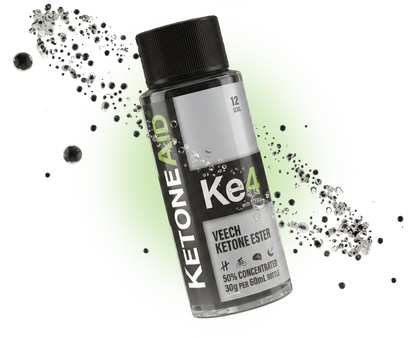
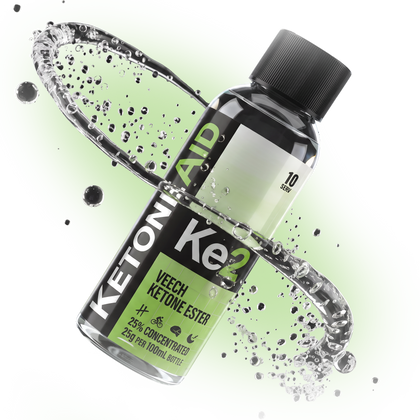
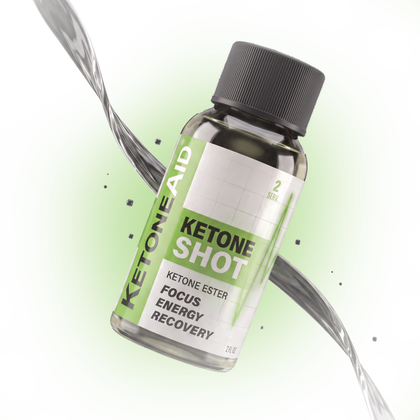
%VKE concentration decides taste. Same Veech Ketone Ester in all three, just at different dilutions.

Strong, bitter and most compact.
Not “better”, just less water.

3x the water of Ke4, same price per g as Ke4. Balanced value & taste.
25g VKE per btl. · 'Not Bad'
Ready to drink, nothing to measure.
1st time? Taste an issue? Start Here.


Real Buzz. No Booze.™(not for focus+performance)
 Focus & cognitionDemanding workdays, exams, long meetings
 Stamina & enduranceLong efforts without the crash
 Healthy aging & muscleStaying strong past 50
 Sleep after trainingA small amount before bed
 "Ketosis" & fastingKetones without the diet
 RecoveryAfter hard sessions and back-to-back days
 Basketball
 Climbing
soon
 Combat sports
 Cycling
soon
 Golf
soon
 Motocross
soon
 Pickleball
soon
 Running
soon
 Soccer
soon
 Swimming
soon
 Tennis
soon
 Triathlon
soon
Backpacking
soon
Gaming
soon
%VKE concentration decides taste. Same Veech Ketone Ester in all three, just at different dilutions.
Very Scary 🍒 • 30g VKE / btl.
Not 'better'. Just less water.
'Not Bad' 🍏 flavor • 25g / btl.
Same price per g VKE as Ke4,
just 3x more water.
'Almost Yummy' 🍑 • 5g / btl.
More $/g for convenience+flavor.
1st time? Taste an issue? Start here
Real Buzz. No Booze.™(not for focus+performance)
Basketball
Climbing
soon
Combat sports
Cycling
soon
Golf
soon
Motocross
soon
Pickleball
soon
Running
soon
Soccer
soon
Swimming
soon
Tennis
soon
Triathlon
soon
Backpacking
soon
Gaming
soon
Carrito
Su carrito está vacío
The two molecules share a metabolic pathway and both raise blood D-BHB, so the question gets asked a lot. The answer depends on which of five things is actually the same — and only one of them is.
No, not automatically. Research on the Veech Ketone Ester is direct evidence for the Veech Ketone Ester. Free R 1,3 butanediol has a related metabolic pathway but is a different administered molecule, with different pharmacokinetics and its own outcome evidence.
Both can raise blood D-BHB. VKE is not a mixture of D-BHB and free R 1,3 butanediol; it is one bonded ester molecule. After hydrolysis, VKE releases D-BHB directly and R 1,3 butanediol, which then follows the same hepatic conversion pathway described for free R 1,3 butanediol. That shared downstream step does not make the starting molecules, pharmacokinetics, dosing or trial evidence interchangeable. Identity comes first: a study describes the molecule it administered. Whether it then supports a specific claim depends on dose, protocol, population and the outcome measured — and those have to match too.
When a butanediol product points at ketone-ester research, ask which of these it is claiming. Run down the list for the Veech Ketone Ester and free R 1,3 butanediol.
VKE itself is one intact bonded molecule. After hydrolysis, it releases one D-BHB molecule directly and one R 1,3 butanediol molecule; the released diol then follows the same hepatic conversion pathway described for free R 1,3 butanediol.
So a butanediol-derived conversion step is part of how the ester delivers ketones. Here is why that does not make a free R 1,3 butanediol product equivalent to the intact ester, or let it inherit the ester’s trial results.
The two routes are drawn step by step on the metabolism page; this page does not repeat them.
Shared downstream metabolism ≠ same administered molecule ≠ same pharmacokinetics ≠ same outcome evidence.
Four kinds of Veech Ketone Ester study, read through the identity-then-applicability framework. In each row, the first question is which molecule was administered.
| The study | Direct evidence for | For free R 1,3 butanediol |
|---|---|---|
| Human kinetics of the esterClarke 2012 · Stubbs 2017 | How much BHB the intact ester delivers, how fast, and for how long — 2.8 mM at 12–24 g, a 3.30 mM peak at 714 mg/kg, back to baseline in 3–4 h. | Does not transfer. The free diol has its own kinetics: about 1.2 mM peak from 10 g, about 2.1 mM from 34.5 g in three fasted servings, with a later peak.Falkenhain 2024 · Lowder 2023 |
| Both molecules, same people, same doseFalkenhain 2024 | The one head-to-head: at a matched 10 g in twelve fasted adults, the ester rose about +1.7 mM above baseline, free R 1,3 butanediol about +0.8 mM.* | This is evidence about the free diol — because it dosed the free diol. It shows the biomarker itself does not carry over at equal grams. |
| Repeated-use ester trial with a measured outcomePoffé 2019 | Physically active young men, 25 g of the ester after exercise and before sleep for three weeks of overload: sustainable training load and late-endurance power about 15% higher than control. | Does not transfer. Identity fails at link 2. There is no free-diol trial of this protocol, and a kinetics study cannot stand in for one. |
| Acute ester trials with a measured outcome — positive, unchanged and negativeMcCarthy 2023 · Poffé 2021 · Prins 2026 | What the ester did under those doses and protocols, including two short time trials where power was 1.5–2.4% lower. | Does not transfer — in either direction. The ester’s negative results are not the diol’s either. A molecule inherits neither the wins nor the losses of another. |
* Approximate rise above baseline calculated from the published baseline and peak values, not treatment-effect figures quoted verbatim from the paper. A twelve-person pharmacokinetic pilot; it measured BHB exposure, not performance or cognition.
The Veech Ketone Ester, under the protocols tested
Positive, unchanged and negative results alike — all of them describe the intact molecule that was administered.
A different administered molecule
Free R 1,3 butanediol shares a pathway and a ketone body. It does not share the trials.
The same thing that substantiates one for any molecule. Nothing about the shared pathway lowers the bar or raises it.
Human outcome evidence on free 1,3-butanediol has to be evaluated on its own formulation and protocol.
The examples on this page are one racemic R,S-1,3-butanediol cycling trial and one endurance trial whose abstract does not state the administered isomer; neither showed an endurance-performance benefit. Two human kinetics studies describe how (R)-1,3-butanediol raises D-BHB. These examples are not presented as a complete review of every free-diol outcome paper. They are enough to demonstrate the evidence-transfer rule: an ester trial cannot substitute for a free-diol trial, and a free-diol trial cannot substitute for an ester trial.
KetoneAid products are Veech Ketone Ester. Free R 1,3 butanediol can raise a BHB reading, but it does not inherit VKE results — it has to earn its own.
Buying rule = evidence rule: match the molecule, then find your dose. Start low, work up.
Two routes to the same ketone body, with the human kinetics side by side. How you get to those D-BHB numbers matters.
See the metabolism The frameworkIdentity first, applicability second — the five-link chain between a product and a claim.
Run the test The categoryEvery type — ester, R 1,3 butanediol, salts, free acid — with what each has shown in people.
Compare the types The recordEvery indexed Veech Ketone Ester human study, with molecule, material and result.
Browse the studies